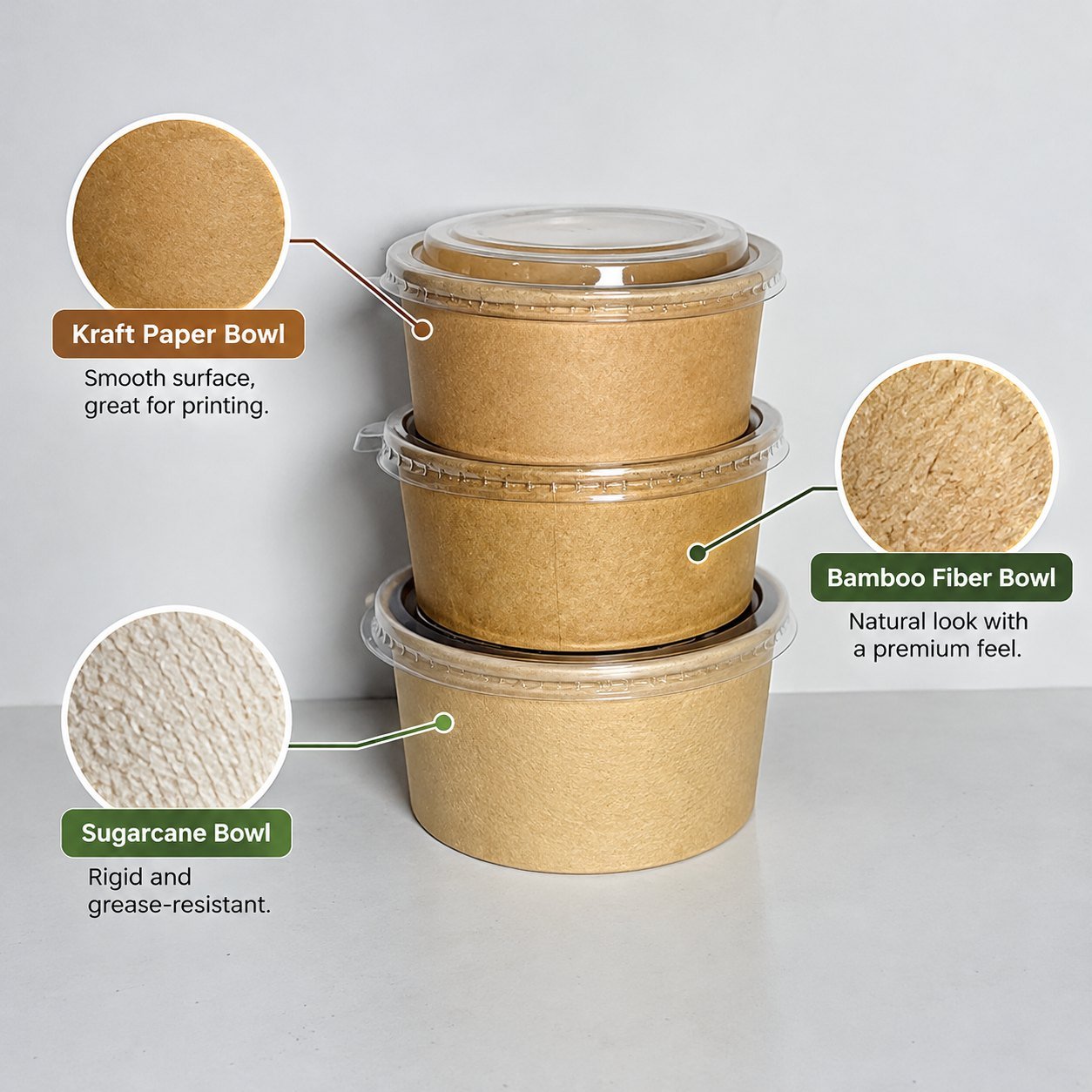
Three compostable bowl materials are available to sourcing teams right now. Kraft paper gives you a smooth, printable surface for hot and cold food. Bamboo fiber gives you a premium feel at a higher price. Sugarcane bagasse gives you a rigid, grease-resistant bowl made from crop waste. All three compost commercially. The right pick depends on your menu, branding goals, and per-unit budget.
Three Materials at a Glance
Here are the specs that matter most when you compare renewable bowl materials.
| Spec | Kraft Paper | Bamboo Fiber | Sugarcane (Bagasse) |
|---|---|---|---|
| Raw source | Wood pulp from managed forests | Bamboo pulp | Sugarcane milling waste |
| Wall strength | Moderate to high (250–380 gsm typical) | High rigidity, thermoformed | Heavy-duty, molded |
| Look and feel | Smooth brown or white, flat surface | Smooth, natural fiber, premium | Textured, off-white or natural brown |
| Best use | Branded takeout, hot and cold food | Upscale dining, catering events | Greasy food, hot soup, curry |
| Compost time (commercial) | Within 90 days (water-based coated) | 90–180 days | 45–90 days |
| Heat tolerance | Up to 95°C (coated) | Varies by product, up to 200°C | 100–120°C |
| Grease resistance | Needs a coating | Naturally resistant | Naturally resistant |
| Printability | Excellent, full-color | Limited | Limited, textured surface |
| Relative cost | Lowest | Highest | Mid-range |
All compost times assume commercial facilities. PE-coated kraft does not compost. Confirm coating type and certification status with your supplier before making any compostability claim.
Kraft Paper Bowls: The Printable, All-Purpose Option
Kraft paper is the most widely used material for disposable food bowls. Raw material comes from managed forest pulp, and the supply chain runs at a scale that keeps per-unit costs lower than what you would pay for bamboo or bagasse.
The surface is smooth and flat. That gives you the best print canvas of all three materials. Full-color flexographic or offset printing with a logo, pattern, and regulatory text all work on the outer wall. Bamboo and bagasse have textured surfaces that limit print resolution.

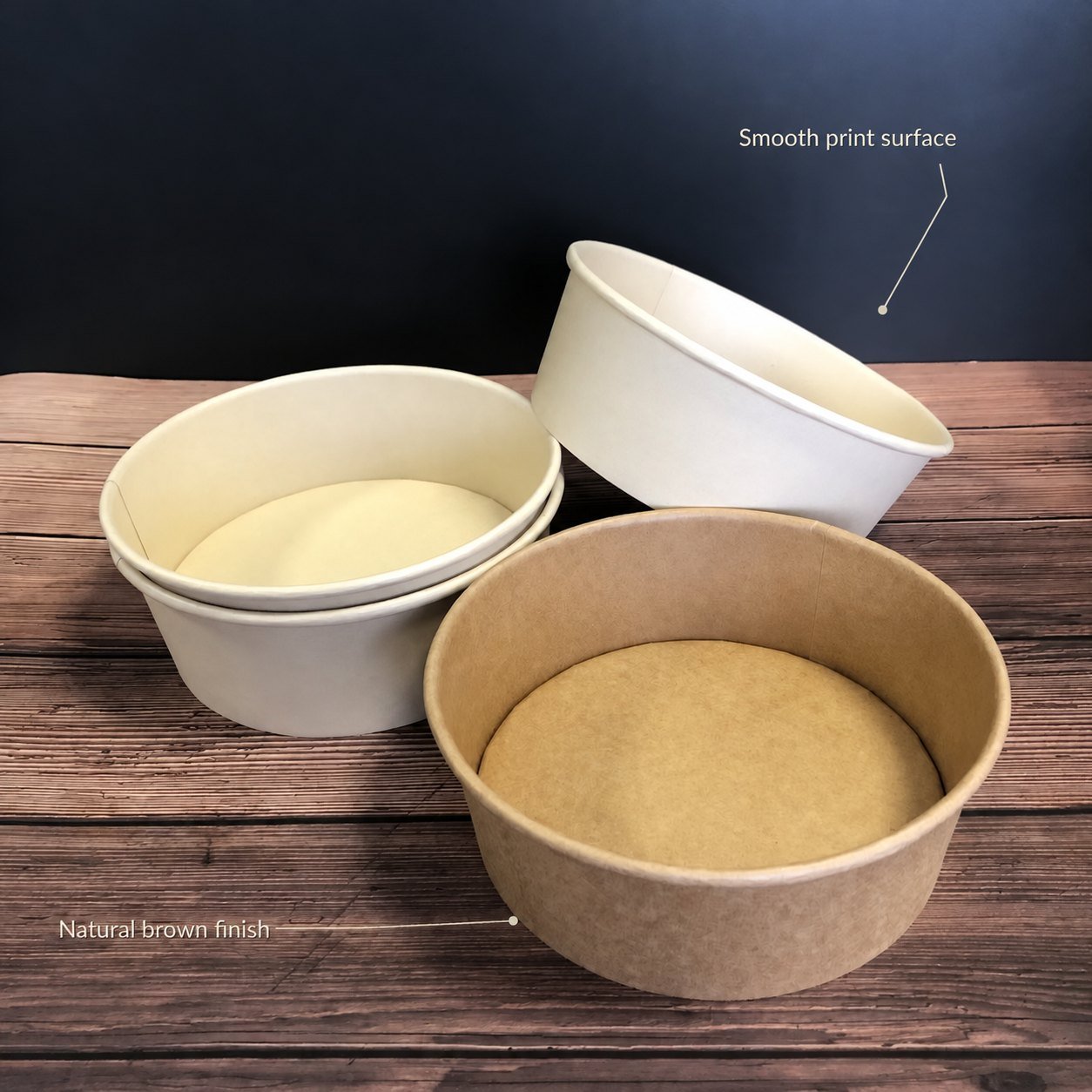
The coating you choose determines what the bowl can handle. A water-based (aqueous) barrier keeps the bowl microwave-safe and compostable. PE lamination gives stronger moisture resistance but blocks composting and is not microwave-safe. For more on how coating type affects microwave performance, see Are Paper Bowls Microwave Safe?
If you are sourcing for hot food service, kraft bowls in the 250 to 380 gsm range hold their shape under hot soup, oatmeal, or chili at temperatures up to 95°C. For a deeper comparison against plastic and foam, see Paper Bowls vs Plastic vs Styrofoam.
If you choose a water-based coating, kraft bowls break down in commercial composting within 90 days. Published wholesale estimates put compostable paper bowls at roughly $0.045 to $0.062 per unit, making kraft the most affordable of the three.
Bamboo Bowls: Smooth Finish, Premium Price

Bamboo fiber bowls start as bamboo pulp, vacuum-formed and hot-pressed. The finished product has a smooth, natural appearance that reads as premium in a dining or catering setting. Manufacturing temperatures and exact specs vary by mill, so request the supplier’s own spec sheet for the SKU you are evaluating.
Published pricing puts bamboo bowls at roughly $0.10 to $0.20 per unit or more, the most expensive of the three options. The cost reflects a smaller supplier base and more specialized manufacturing. Per-unit spend runs 50 to 100 percent above what you pay for kraft. If the per-plate margin in your operation supports it, that cost is easier to absorb.
Bamboo fiber resists oil and moisture without a plastic or PLA lining. That is a real advantage if you want to skip chemical barriers entirely.
Composting typically takes 90 to 180 days under industrial conditions, the longest of the three options. These figures are typical for bamboo mills. Request the supplier’s own compost report for the exact SKU you are evaluating. Home composting data for bamboo is limited, so ask the supplier if end customers need that.
Printability is more limited. The natural fiber surface takes logo placement through sleeves and labels, but texture and color variation reduce what you can do with full-wrap designs compared to kraft.
Bamboo bowls make sense when you need the packaging to signal quality at a premium table. Think upscale restaurants, plated catering, and farm-to-table brands.
Sugarcane Bowls: Crop Waste Turned Grease-Proof Packaging
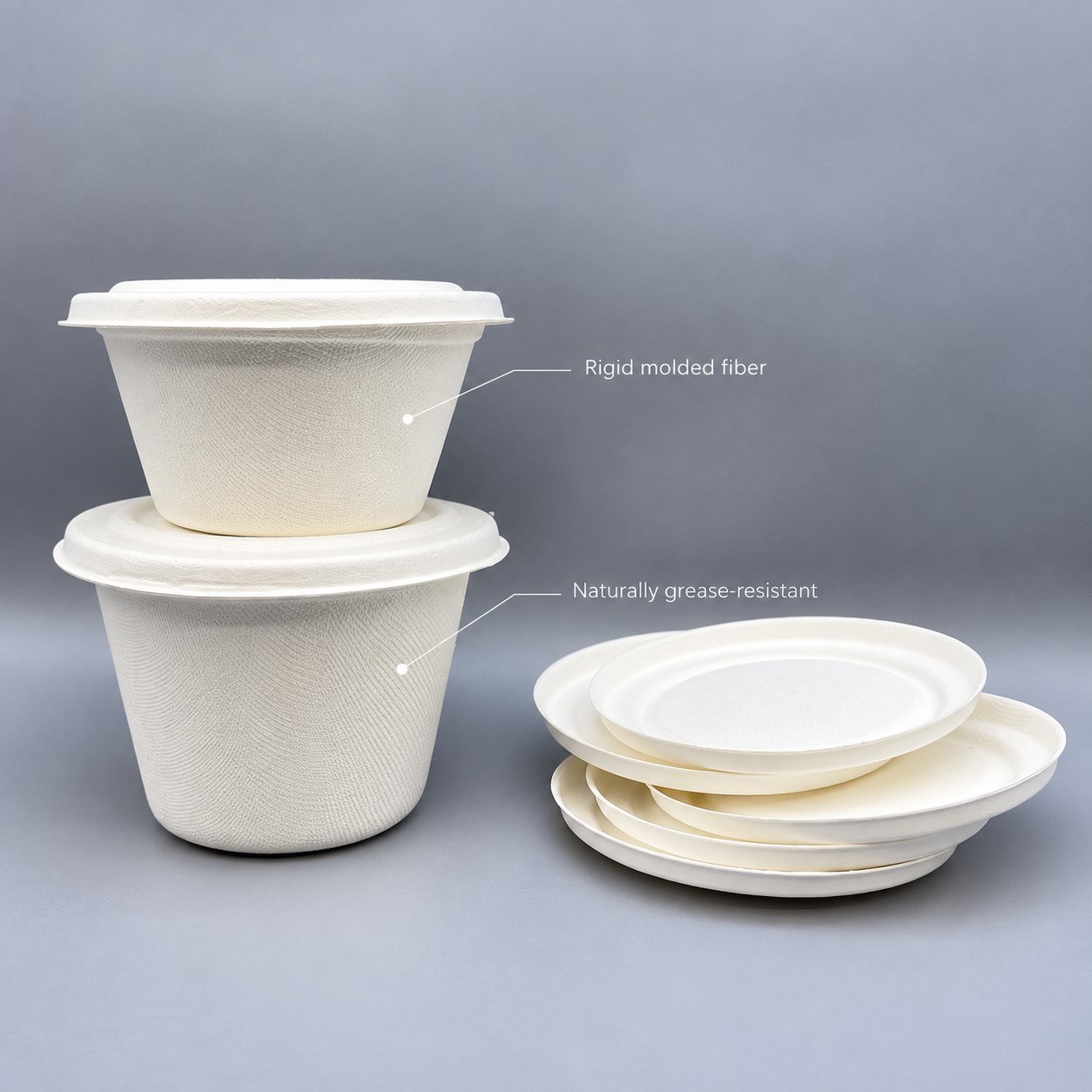
Bagasse is the dry, fibrous material left after sugarcane stalks are crushed for juice. When you source bagasse bowls, the packaging material is agricultural waste given a second life instead of being burned or landfilled.
The standout feature is natural grease and oil resistance. If you serve oily foods, bagasse bowls hold fried rice, curries, and stir-fries without leaking through the wall. Kraft paper needs a coating to match that. Bagasse does it without one.

Heat tolerance runs higher too. Published specs put bagasse at 100 to 120°C, and the bowls handle microwave reheating well. That gives you a wider thermal window than kraft.
If you need the fastest commercial compost time of the three, bagasse wins at 45 to 90 days under commercial conditions. Some formulations also carry home-compostable certifications under TÜV Austria OK compost HOME.
The trade-off is the print surface. Bagasse is molded, not pressed from a flat sheet. The texture makes high-resolution printing difficult. If you need a full-wrap design, bagasse limits the options.
Published pricing puts bagasse bowls at roughly $0.04 to $0.12 per unit FOB, which gives you a per-unit cost that sits between kraft and bamboo.
Match the Bowl to the Menu
The material you pick should follow the menu format, not the other way around. Here is a practical guide for the five most common use cases.
Greasy and oily food. Bagasse handles grease without a coating, so you skip the barrier cost and keep compostability claims simpler. Kraft works too, but a grease-resistant barrier is required, which adds cost and may complicate compostability claims.
Hot soup and liquid-heavy items. Kraft paper bowls with a water-based coating handle temperatures up to 95°C. Bagasse gives you a higher ceiling at 100 to 120°C if the operation includes microwave reheating. For sizing, see Paper Bowl Sizes Explained.
Cold food, salads, and grain bowls. All three materials handle cold food well. Grease resistance and heat tolerance matter less here. Pick based on branding needs and budget. Kraft gives you the best print surface at the lowest cost per unit.
Premium dining and catering. Bamboo bowls signal quality through their look and feel. The higher cost per unit is easier for you to absorb when per-plate margin supports it.
High-volume takeout and delivery. Kraft is the standard for what you need here. Full-color branding at the lowest unit cost, printed directly on the bowl wall.
Certifications and the XINNENG Kraft Line
Whatever material you choose, the certification checklist stays the same.
BPI certification (US and Canada, ASTM D6868 for coated paper) confirms the bowl composts within a tested timeframe. EN 13432 is the EU equivalent. Ask the supplier for the certificate number and test date so you can verify it before ordering. For a deeper look, see Compostable Paper Bowls: What “Eco-Friendly” Really Means.
PFAS-free status matters across all three. New York has banned food packaging with intentionally added PFAS since December 31, 2022. Washington banned wraps, plates, food boats, and pizza boxes on February 1, 2023, and extended the rule to bowls, bags, sleeves, and containers on May 1, 2024. California, Minnesota, and Connecticut have their own provisions. Require a written PFAS-free declaration from any supplier you work with.
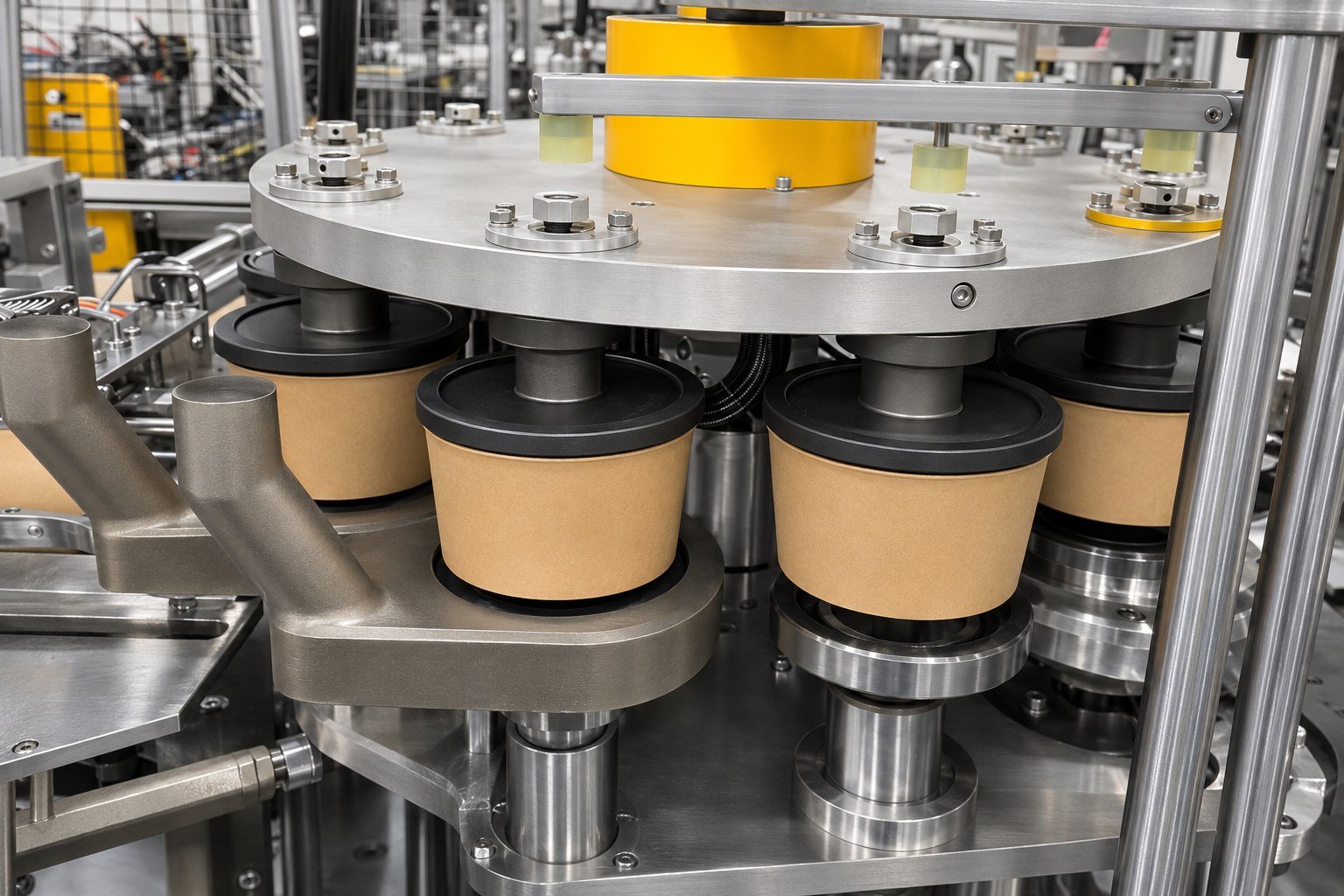
XINNENG manufactures kraft paper bowls. They do not produce bamboo or bagasse bowls. If kraft fits your menu and branding goals, here is what the line gives you.
Open paper bowls come in 8, 12, 16, and 26 oz with paper weight from 250 to 380 gsm. Choose PE lamination or a plastic-free water-based barrier for the coating you need. Heat tolerance reaches 95°C. Paper soup containers come in 16, 24, 32, 48, and 64 oz as matched bucket-and-lid sets, with grammage from 300 to 380 gsm, rated from -20°C to 100°C.
XINNENG holds ISO 22000 food safety management certification for compliance documentation. That covers food safety systems, not compostability or heat performance. An in-house lab and annual third-party testing back that certification, so you have documentation ready for compliance audits.
Custom printing starts at 10,000 pieces per size and design. Same-artwork orders across sizes can combine to hit that minimum. Lead time runs about one week for a 10,000-piece order and roughly 15 days for bulk production. Submit artwork as Adobe Illustrator (.ai), PDF, or EPS files with fonts outlined. Sampling starts with a free e-proof for you to approve the layout, then a $14 physical mock-up or a $70 on-press sample using real print material (refundable against the bulk order).
Browse the Full Kraft Range
Browse the full kraft range on the XINNENG paper bowls category page to see what you can order.
FAQ
Which bowl material handles greasy food best?
If your menu runs oily, bagasse is the simplest pick. Sugarcane (bagasse) bowls resist grease and oil without a coating. Kraft paper needs a grease-resistant barrier. Bamboo fiber is also naturally resistant, but costs significantly more per unit.
Do all three materials compost?
All three break down under commercial composting. Bagasse is fastest at 45 to 90 days. Water-based coated kraft composts within 90 days. Bamboo takes 90 to 180 days. PE-coated kraft does not compost. Confirm the coating type with the supplier before you make any compostability claim.
Which material gives the best branding surface?
Kraft paper gives you the best branding surface of the three. The smooth, flat wall supports full-color flexographic and offset printing at high resolution. Bamboo and bagasse bowls have textured surfaces that limit design precision and color fidelity.
Is the bamboo premium worth paying for?
That depends on the customer profile and per-plate margin. Bamboo bowls cost roughly 50 to 100 percent more than kraft per unit. They make sense for premium dining and catering where the bowl itself is part of the presentation. For high-volume takeout, kraft or bagasse gives you a stronger return on each unit.
Start With a Kraft Sample Kit
Request a sample set from XINNENG. Send the sizes, monthly volume, and coating preference. You get back matched specs, tiered pricing, and a free e-proof to test the design before production.