Paper bowls run from about 4 oz up to 32 oz across most suppliers. The right one for you depends on what’s going inside it. A 4 to 8 oz bowl fits a sauce, a dip, or a small side on your menu. A 12 oz bowl covers a standard soup serving. A 16 oz bowl holds most full entrées. A 24 to 32 oz bowl fits a family-style or meal-prep portion. Our own paper bowl line runs 8 to 26 oz, and its separate paper soup container line picks up anything larger or lidded. Match your size to your actual portion, not a round number that just sounds right, and you cut your food cost and your plate waste in the same move.
Quick capacity chart: ounces, milliliters, and use
Here’s the general size range you’ll see across the paper bowl market. It’s not a list of what every single supplier stocks. Check which of these your own supplier actually carries before you build a menu around one.
| Capacity | Roughly in ml | Typical food | Best for |
|---|---|---|---|
| 4 oz | ~120 ml | Dipping sauce, condiment | Side orders, sampling |
| 6 oz | ~180 ml | Small side, appetizer | Quick-serve sides |
| 8 oz | ~240 ml | Small soup, side salad | Cup of soup, snack bar |
| 10 oz | ~300 ml | Light soup, small salad | Lunch counter sides |
| 12 oz | ~360 ml | Standard soup bowl | Soup and salad spots |
| 16 oz | ~480 ml | Full entrée, ramen, chili | Sit-down and takeout mains |
| 20 oz | ~590 ml | Large entrée, loaded bowl | Build-your-own bowl concepts |
| 24 oz | ~710 ml | Family-style side, meal-prep | Catering, meal-prep kits |
| 32 oz | ~950 ml | Bulk family portion | Large catering, meal-prep |
XINNENG’s own confirmed paper bowl line covers four of these sizes directly: 8, 12, 16, and 26 oz. You can order any of those four as a real SKU, not just a chart entry. For anything above that, or anything that needs a true sealed lid, its paper soup containers pick up the range at 16, 24, 32, 48 and 64 oz instead.


Portion control and cost: right-size to cut waste
Your bowl size quietly sets your portion size. Staff tend to fill a container until it looks full, not to a measured weight. Hand your team an oversized bowl, and you’ll likely see an oversized scoop go in it too.
That habit costs you twice. You pay more in food per order than your recipe calls for, and you also pay more per unit for a bowl bigger than the dish needs. Matching your bowl to your actual recipe portion fixes both problems at once.
Don’t guess your way into this fix. Weigh your actual recipe portion for your top few menu items, then pick the smallest bowl that holds it with a little headroom. XINNENG’s four stock sizes give you enough steps that you’re rarely forced to round up just to find something that fits.
By menu type: soup, salad bar, meal-prep, catering
Your menu type points you toward a size range before you even look at a single dish.

Soup and noodle spots usually center on 12 to 16 oz, with an 8 to 12 oz side cup for smaller orders. A full bowl of ramen or pho needs the extra headroom a 16 oz bowl gives you.
Salad bars and build-your-own counters split across two sizes. An 8 to 12 oz bowl works for a side salad, and a 16 to 24 oz bowl handles a full meal salad loaded with protein.
Meal-prep kitchens lean toward your largest practical size, usually 24 to 32 oz, since one container often holds an entire meal for you: a protein, a starch, and a vegetable side together.
Caterers usually stock the widest spread. Often all four sizes. One event can call for small dessert portions and large family-style sides on the same table. A mixed case works better than betting on just one size.
Diameter vs depth: why depth matters for soup
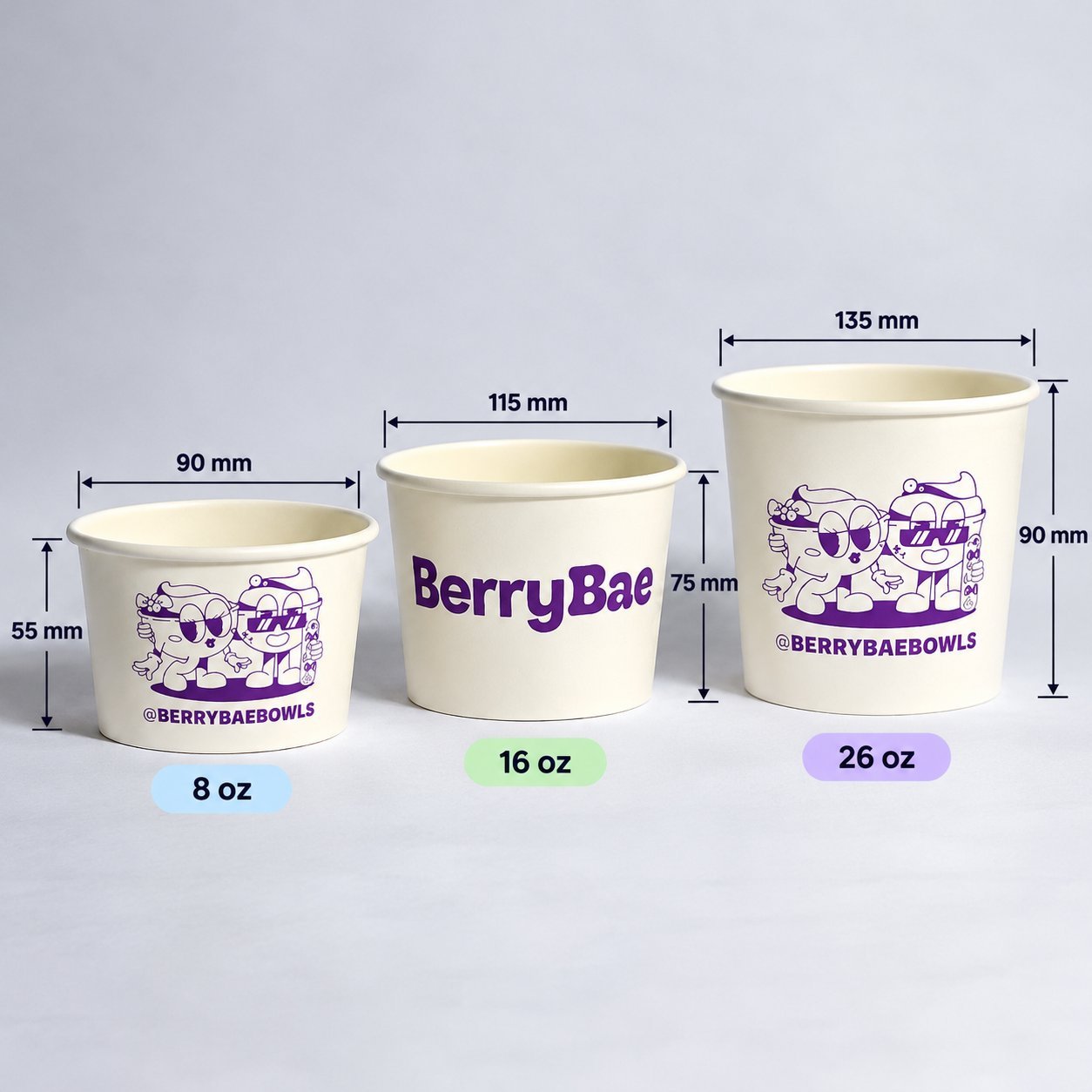
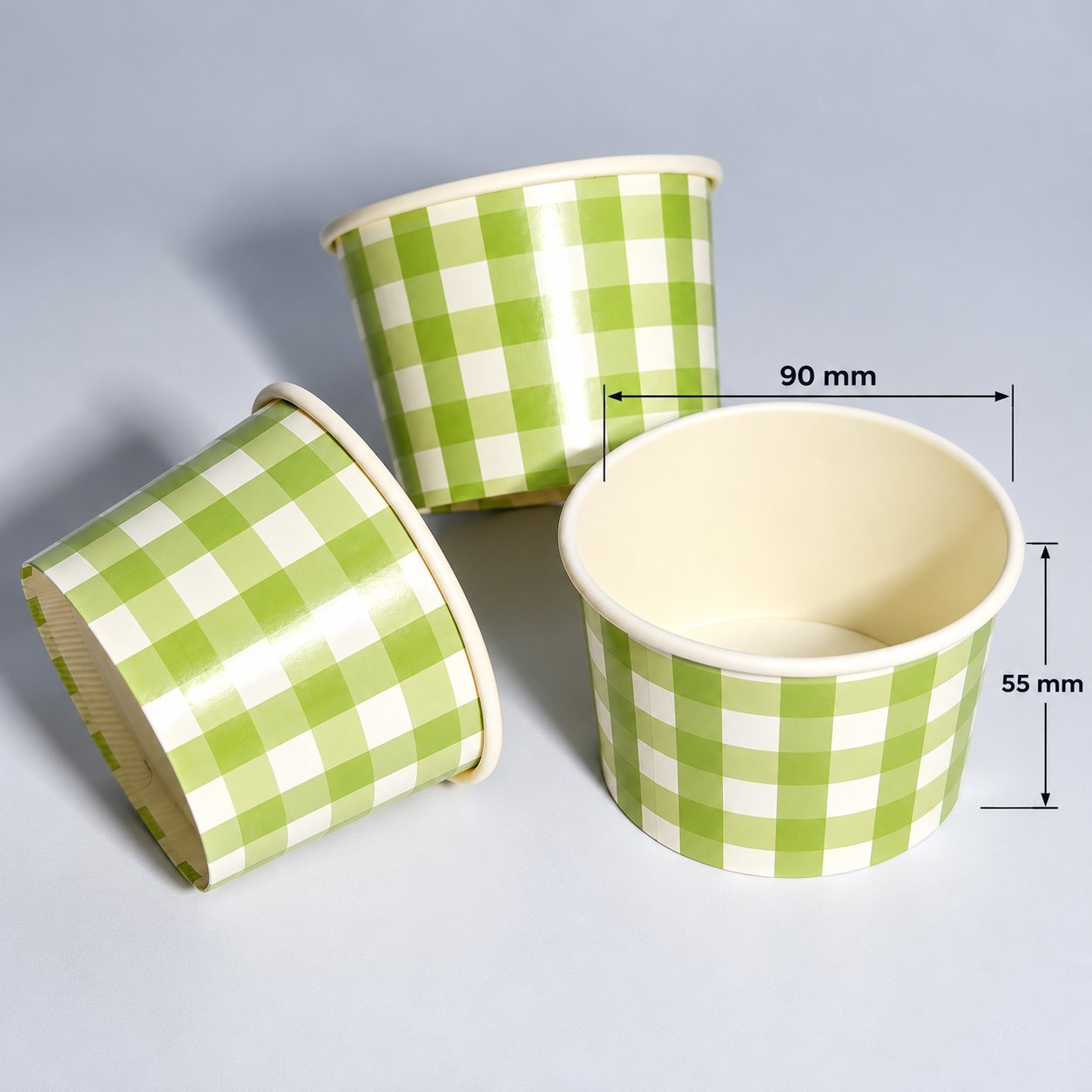
A bowl’s capacity comes from both its width and its depth (height). These two dimensions don’t scale together the same way across every size, so you can’t judge capacity from diameter alone. XINNENG’s spec table shows the pattern. Its 8 oz bowl runs 90mm across the top and 55mm deep. Its 26 oz bowl runs 135mm across and 90mm deep, with depth growing faster than the top diameter. 64% versus 50% from 8 oz to 26 oz.
Depth matters more than width for anything liquid. A wide, shallow bowl sloshes and splashes the moment someone carries it, especially with hot broth near the rim. A narrower, deeper bowl keeps the liquid surface further below the rim, so there is less room for it to slosh on the way to the table.
Depth also decides whether toppings fit. A loaded ramen bowl needs real height above the broth for noodles, egg, and garnish to sit without spilling over. If your dish needs that headroom, size up by depth and check the actual height number before you commit.
Mixing a case assortment for a new account
If you’re a brand-new account, you probably don’t know your real size split yet. Most buyers start with a reasonable estimate instead and adjust from there.
A common starting point splits your order three ways. Roughly 25 to 30 percent goes small, at 8 oz. Another 40 to 45 percent goes medium, at 12 to 16 oz. The rest goes large, at 20 oz and up. Treat this as a starting point to adjust, not a fixed formula. Your actual menu mix, average order size, and dine-in versus delivery split all shift these numbers.


Track your first month of actual usage by size, then rebuild your next order around what you really sold. Look for a supplier that lets you combine same-artwork orders across sizes. XINNENG allows exactly that. It makes early adjustment far less costly than committing to one size at full volume.
Bulk and custom: MOQ per size, combo pallets
Custom printing normally starts at 10,000 pieces per size and design. If you use the same artwork across several sizes, we can combine them into one run to meet that total. Confirm the exact split with us before ordering. Blank, unprinted stock carries a lower minimum if custom branding isn’t a requirement yet.
Lead time runs about one week for a 10,000-piece order, and about 15 days for a larger run from 50,000 up to 200,000 pieces, plus shipping. Six factors drive your actual price: capacity, material and coating, print area and color count, order quantity, accessories like lids, and final packaging. Never price your order off capacity alone, since a small bowl with heavy branding can cost more per unit than a plain large one.
A free digital e-proof confirms your layout first. A physical mock-up sample runs about $14 and takes roughly 3 days. An on-press sample using your real print material runs about $70, refundable against your bulk order.
XINNENG’s paper bowl range
XINNENG’s confirmed paper bowl line runs four sizes. Each one has its own real spec sheet, so you can check your exact bowl’s numbers instead of guessing from a rounded range.
| Capacity | Top diameter | Base diameter | Height | Paper weight |
|---|---|---|---|---|
| 8 oz | 90mm | 60mm | 55mm | 250–300 gsm |
| 12 oz | 105mm | 70mm | 65mm | 280–330 gsm |
| 16 oz | 118mm | 78mm | 75mm | 300–350 gsm |
| 26 oz | 135mm | 90mm | 90mm | 330–380 gsm |
All four sizes use a PE or water-based coating rated to 95 °C. Packing runs 50 pieces per sleeve and 1,000 per carton for the two smaller sizes, dropping to 25 per sleeve and 500 per carton for the two larger ones, since bigger bowls simply take more room per case.
Your account might need something past 26 oz, or a true sealed lid instead of an open top. XINNENG’s paper soup containers cover that range, extending the range at 16, 24, 32, 48 and 64 oz. They’re sold as matched bucket-and-lid sets, not open bowls, since a lidded bucket and an open bowl aren’t the same product even at a matching capacity.
Relevant XINNENG paper bowl category
Use the XINNENG paper bowls category as the natural next step from comparison to sample request, then confirm the exact coating, documentation and tested range for your order.
XINNENG holds ISO 22000 food safety management certification and National High-Tech Enterprise status, backed by an in-house lab and annual third-party testing. Those certifications cover food safety management broadly, not a specific size claim, so ask for your exact size’s own spec sheet before you order.
FAQ
What size paper bowl should you use for a standard cup of soup?
A 12 oz bowl covers most standard servings. Size down to 8 oz for a smaller side cup, or up to 16 oz for soup loaded with noodles or toppings.
What size counts as a large paper bowl?
Most suppliers treat 24 oz and up as large, suited to a family-style portion. XINNENG’s open-bowl line tops out at 26 oz, with its paper soup containers extending further.
Do you need a different bowl size for hot soup versus a cold salad?
Not strictly by size, but depth matters more for hot liquid. A deeper bowl holds hot broth with less sloshing, while a wider, shallower bowl suits a cold, dry salad at the same capacity.
What’s the difference between a paper bowl and a paper soup container at the same capacity?
A paper bowl is open on top, built for sides you serve right away. A paper soup container is a matched bucket-and-lid set, built for a sealed, full liquid portion that might travel.
What’s the minimum order for a custom-printed paper bowl size?
Most custom-printed orders start at 10,000 pieces per size. Combining the same artwork across two or three sizes can help you reach that faster.
Get your size chart and bulk quote
Ask XINNENG for its current size chart across the full paper bowl and paper soup container ranges. Get a bulk quote for your exact size mix in the same request. Ask for a free sample set across two or three sizes too, so you can test real portions against your menu first.
If you need help choosing a coating and lid type, our soup bowls buying guide covers leak-proof picks in detail. For event and catering orders, our party and catering bowl guide covers stacking, coating stamina, and seasonal custom prints. Our material comparison guide breaks down how paper, plastic, and foam perform under hot-food conditions. And if you want to verify compostability claims before ordering, our compostable paper bowls guide explains what the certifications actually cover. For microwave reheating questions by coating type, see our microwave safety guide.
That one conversation tells you more about your right size mix than a generic chart ever could on its own.