Recovering fibre from a paper cup is possible, and whether your cup actually gets recycled is a different question. The answer depends on four things: how the cup is built, whether your local programme collects it, whether a sorting facility keeps it in the bale, and whether a mill nearby will take it. Change the city and the answer changes with it. This guide covers what physically happens to a cup, where recovery is running as of late 2026, and what you can put on packaging without creating a problem for yourself.
What happens to a cup inside a repulper
Recycling a paper cup means recovering the fibre and discarding the lining. Your cup goes into a repulper with water and agitation, the fibres separate from one another, and the polyethylene film is screened out.
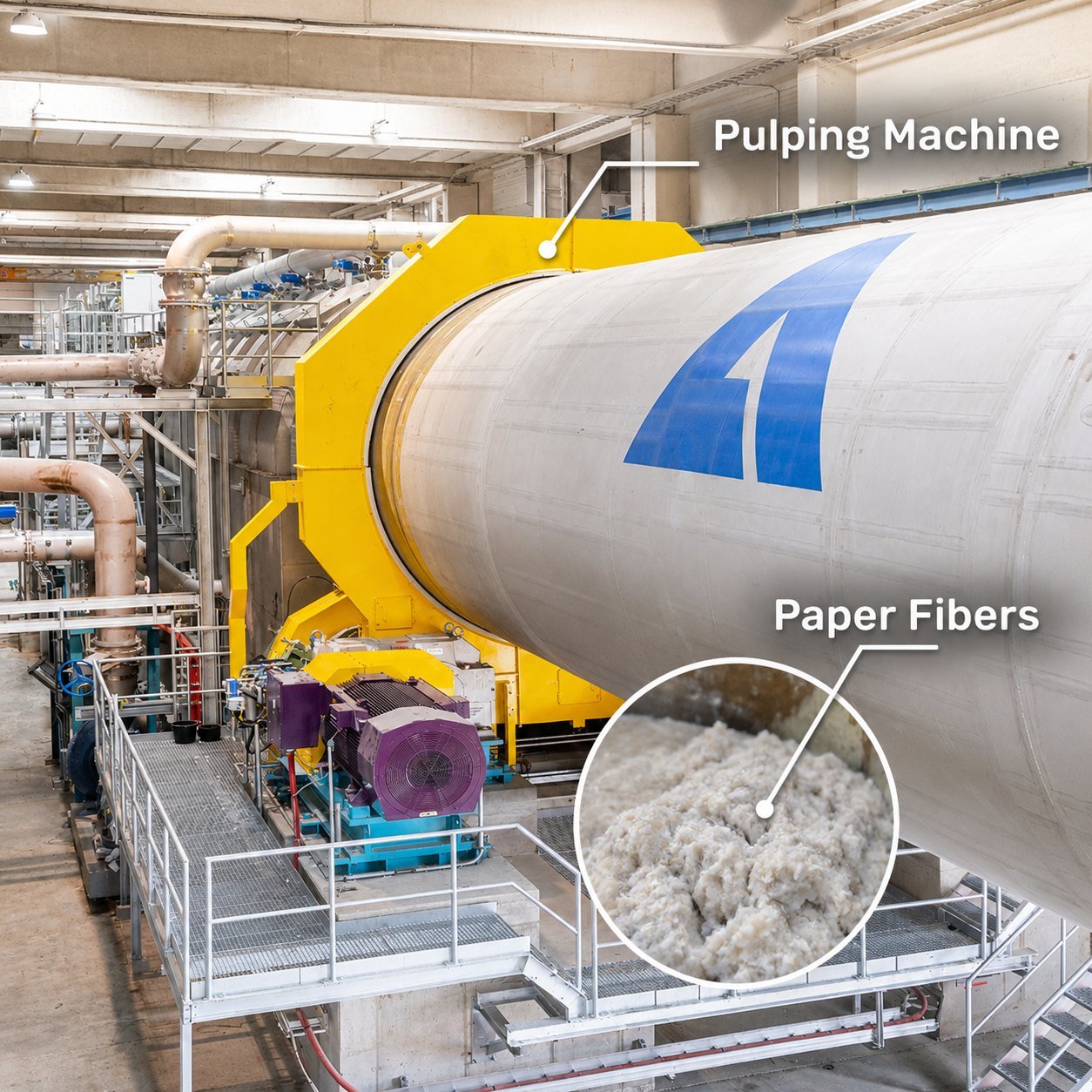

The American Forest and Paper Association describes the general process in its 2021 design guidance for recyclability: “Contaminants like staples, plastic liners, coatings, tape and adhesives are separated and sent for disposal.” The fibre carries on into the recycled stock. The lining you paid for does not.
That guidance also draws a distinction you should hold onto. It defines a recycling challenge as something that slows a mill’s pulping process, plugs screening systems or leaves residue on the finished product. It then states directly that “being a challenge does not make something not recyclable.” Harder to process is not the same as impossible, and conflating the two is how the conversation around cups usually goes wrong.
For a sense of what the recovered fibre is worth to a mill, the same guidance notes recycled paper fibres can be reused five to seven times before they get too short to form new product. That is the value you keep in circulation when a cup is actually recovered.
Collection and sorting come before the mill
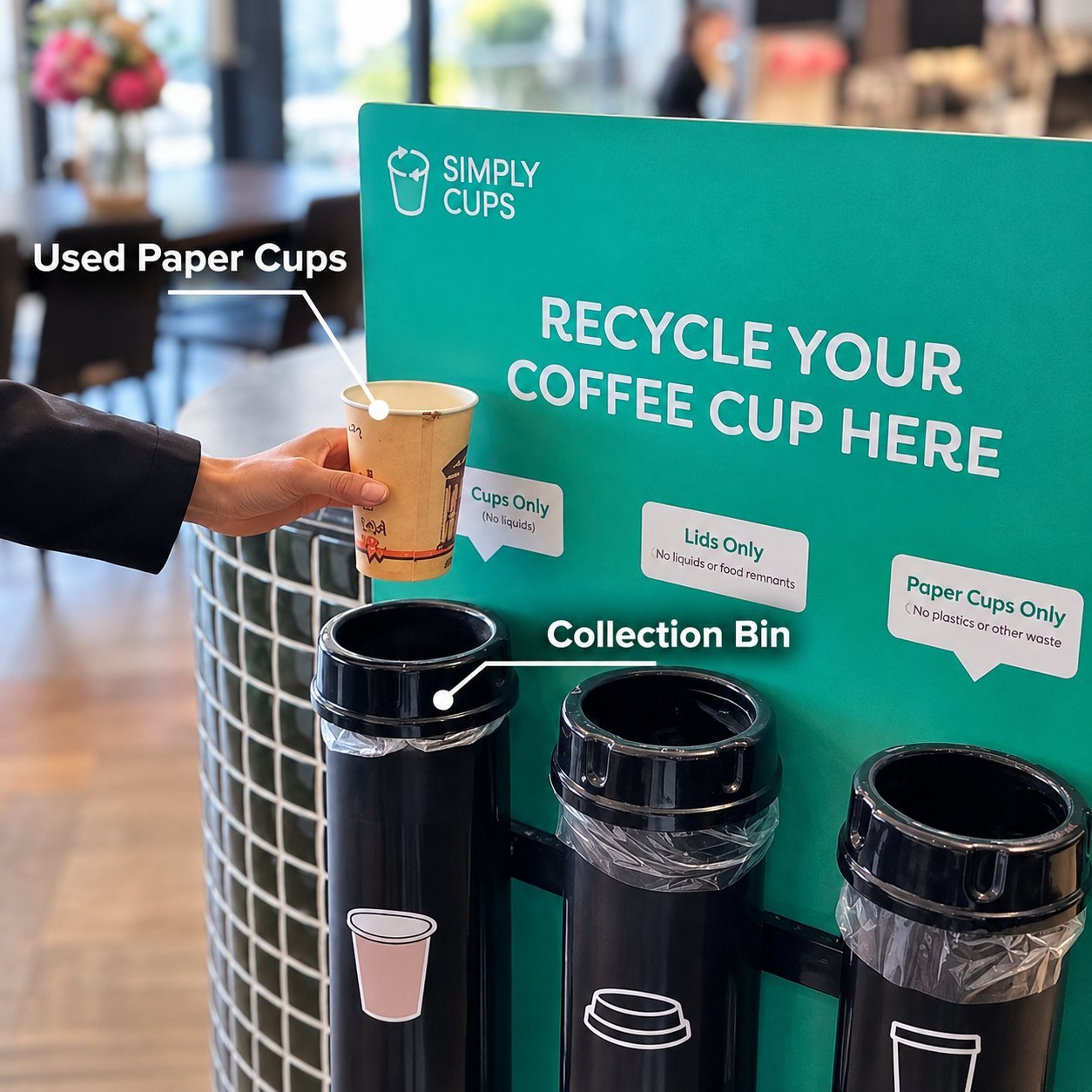
Four separate gates sit between your cup and a recycled sheet of paper, and a cup has to clear all of them. Curbside collection has to accept it. A sorting facility has to keep it rather than pulling it as contamination. The bale specification has to allow it. A mill with the right equipment has to buy that bale.
Reports of cups being sorted out before baling are common, because a lined cup can look like a contaminant on a line built around flat fibre grades. How often that happens varies by facility and by programme, so treat it as a question for your own waste hauler rather than a universal rule.
Two general statistics get quoted in this discussion and both need their scope attached. AF&PA’s 2021 guidance states that more than 90 percent of Americans have access to community paper and paperboard recycling, and gives a US paper recycling rate of 66.2 percent for 2019. Both describe paper broadly. Neither tells you whether a coffee cup is accepted where you operate.
There is a telling gap in the industry’s own data here. Cups were one of the formats AF&PA set out to rate in the mill survey behind that guidance, and the research did not return enough mill survey responses to produce a rating. The document reports the shortfall rather than a negative finding, so read the absence as unresolved rather than as evidence either way. That alone tells you how unsettled cup recovery still was at the time of writing.
Where PE-coated cups are being accepted now
Georgia-Pacific announced on 23 April 2025 that its Savannah River mill in Rincon, Georgia accepts polyethylene-coated paper cups in its mixed paper stock. That made it the third Georgia-Pacific facility to do so, joining recycled paper mills in Green Bay, Wisconsin and Muskogee, Oklahoma. Three mills is the number you are working with as of late 2026.
Three details change how you should read that:
- The scope is cups inside mixed paper bales, not loose cups collected separately, so your bale specification matters as much as your cup.
- The recovered fibre goes into bath tissue, napkins and paper towels, not back into cups.
- Curbside acceptance is an aim rather than a position. Georgia-Pacific describes working with the Foodservice Packaging Institute to expand PE-coated cup acceptance in curbside programmes. No municipalities or dates are named, so do not read the announcement as household access.
On the mechanism, the company says extensive re-pulping trials showed the mills can recapture cup fibre while screening out PE coatings. That is the process you would be relying on.
Older work points the same way, and it is useful background when you push a supplier on this. Research from Western Michigan University cited in the AF&PA guidance refers to a 2009 protocol which found considerable volumes of usable fibre from cup stock were being landfilled, and that cups designed for repulpability could be integrated into the old corrugated container or mixed paper streams.
Read all of this as geography and infrastructure rather than chemistry. Where mills and bale specifications allow it, a PE-coated cup is recoverable. Where they do not, the same cup goes to landfill. Your claim has to follow the infrastructure.
PE, PLA and water-based raise different questions
The coating changes the conversation, and none of the three has a settled answer for cups specifically. AF&PA’s mill survey did not cover cups, so its ratings for other packaging formats cannot decide a cup-level comparison. Treat each of these as something to verify for your exact construction and destination.
Polyethylene. The most common barrier, and AF&PA names drinking cups among its typical end uses. It is the one with named mills publicly accepting it in mixed paper bales. Ask which mills serve your market and what their bale specification allows.
Bioplastic coatings including PLA. AF&PA does not name PLA, grouping it as bioplastic barriers, and rates those a recycling challenge for several paper grades. A compostable coating also offers nothing to a recycling stream, so a cup sold as the greener choice can be the harder one to recover. Ask whether industrial composting actually exists in your market before choosing on this basis.
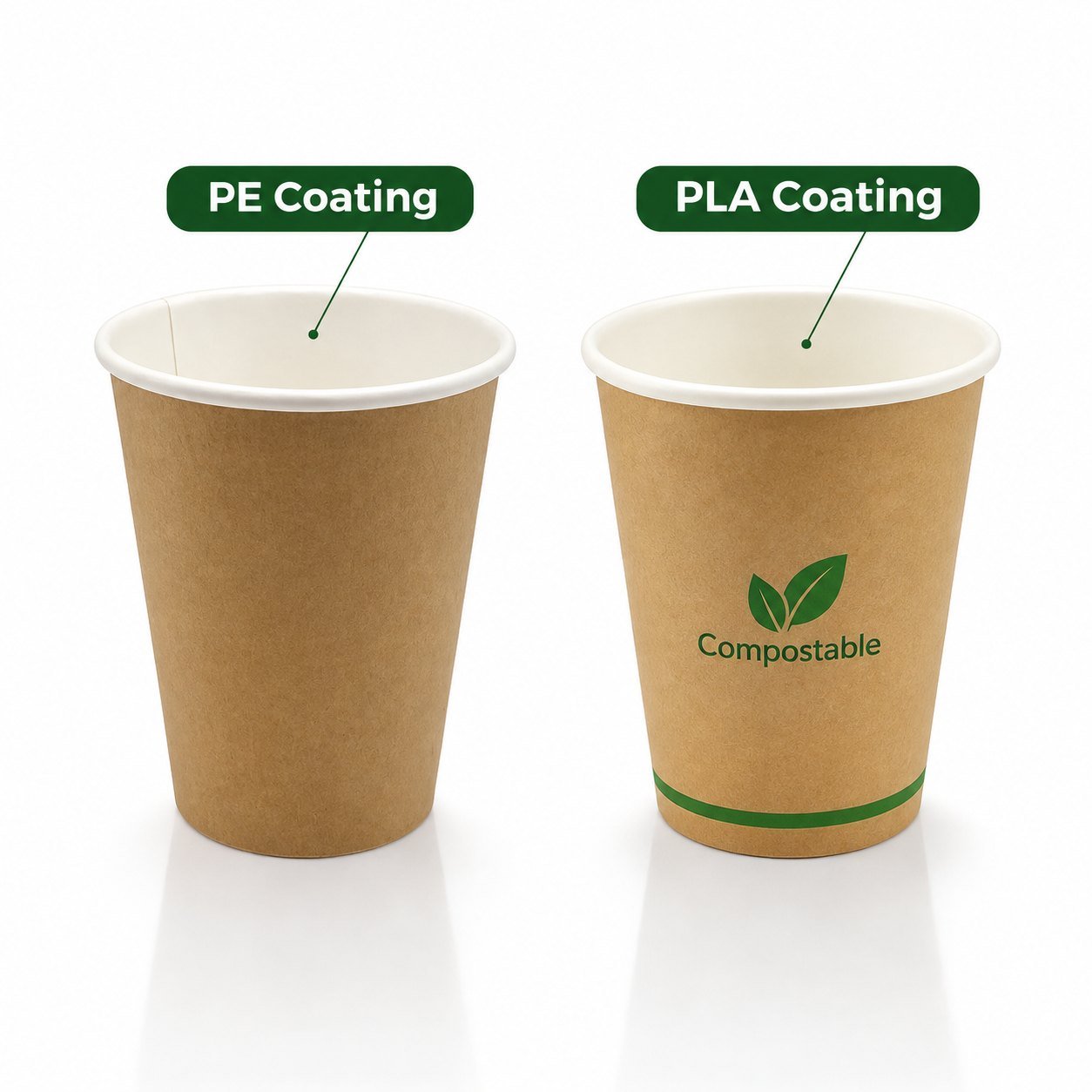
Water-based coatings. Suppliers argue these recover better because there is no plastic film to separate. The direction is plausible. What is generally missing is quantified recovery data and confirmation that named mills accept them, so ask for both rather than treating it as established.
If you are choosing between the three on broader grounds, the PE, PLA and aqueous decision matrix covers heat, cost and disposal together.
Every component needs its own answer

A claim about your cup body says nothing about the rest of the pack. The cup is a fibre product with a lining. The lid is a solid plastic part. A sleeve is another fibre item, and a straw is another plastic one.
Each part can have a different collection route and a different end market. So confirm the lid resin and model in writing for the specific style you are ordering, since it varies by lid type rather than by cup size, then check whether your local programme takes that resin at all. Do not present a cup and lid together as recyclable unless the claim covers both components and the disposal route each one actually takes.
What to do about it
Treat recyclability as a claim you earn for a market rather than a property the cup carries.
Do not print an unqualified recyclable claim without checking the rules where you sell. In the United States the FTC Green Guides treat an unqualified claim as appropriate where appropriate recycling facilities are available to at least 60 percent of consumers in the area where the product is sold, and expect a qualified claim otherwise. That is US guidance, not a global rule, and it does not by itself establish that a specific coated cup is accepted. For other markets check the local rules before approving copy. Our guide to paper cup environmental claims covers the four common claim words and the evidence each needs.
- Check acceptance where you actually operate. Ask your waste hauler and your municipality whether cups are accepted in the stream, rather than reasoning from the material.
- Ask the supplier for specifics rather than adjectives. Request the coating type and weight, any repulpability test for that exact construction with its method and date, and whether any named mill has accepted it.
- Keep plastic-free, compostable and recyclable as three separate claims. Each needs its own evidence, its own standard and its own disposal route. A home-compostable claim needs the test conditions and timeframe on file, and industrial composting has to actually exist for your customer. BPI and EN 13432 certification covers what the compostability route proves and what it does not.
- Keep your claims current. Mill acceptance is moving, as the April 2025 announcement shows, so a statement that was accurate two years ago may be wrong in either direction now.
Where XINNENG stands on this
XINNENG offers three coating routes across its cup range — PE, PLA and a water-based coating — in sizes from 3 oz (60 ml) to 22 oz (700 ml). Printing runs flexo, offset or digital, and uses soy and corn-based eco inks.
Being straight about the limits is more useful to you than a claim. XINNENG does not publish a recyclability certification for its cup bodies, and no cup-specific repulpability test result is listed on the site.
One point to raise directly with any supplier, including this one. GB 11680-1989 appears on the site as the material standard used in quality control. That standard was abolished by China’s standards administration in 2017 and is no longer in force. China’s current mandatory standard for food-contact paper and paperboard, GB 4806.8-2022, has applied since 30 June 2023. Ask which current standard your material is actually tested against, and for the dated test report. A food-contact standard is about safety in any case, and certifies nothing about recyclability.
So if recyclability is a requirement in your tender or retail listing, ask for the coating specification and test data in writing, and pair it with the local acceptance check above rather than relying on a supplier statement alone.
Paper cups from XINNENG
Browse the range on the paper cups category page to see what you can specify, or take the exact figures with you in the paper cup specification sheet.
Sources
American Forest and Paper Association, Design Guidance for Recyclability, version 1.1, 2021. Mill survey scope, cup rating shortfall, contaminant handling, access and recycling-rate statistics.
Georgia-Pacific, Georgia-Pacific opens more opportunities for paper cup recycling, 23 April 2025. Three named mills, mixed paper stock scope, end uses, curbside effort.
US Federal Trade Commission, Green Guides. Recyclable claim guidance for the United States.
State Administration for Market Regulation of China, national standard record for GB 11680-1989, showing status 废止 (abolished) in 2017 and its replacement by the GB 4806.8 series, the current version of which took effect on 30 June 2023.
FAQ
Are paper cups recyclable in normal curbside collection?
In many places they are not collected, even though the fibre can be recovered. Acceptance depends on your local programme, the sorting facility, the bale specification and whether a mill nearby takes that bale. Some mills now accept PE-coated cups within mixed paper, which is changing the picture in specific regions. Check with your own municipality rather than assuming either way.
Why is the plastic lining a problem if mills can screen it out?
It is a processing challenge rather than an absolute blocker. The lining slows pulping and has to be separated and sent for disposal, which costs a mill time and yield. Industry guidance is explicit that being a challenge does not make something unrecyclable, and three Georgia-Pacific mills now take mixed paper bales containing the kind of PE-coated cups you are buying.
Is a PLA-coated cup easier to recycle than a PE one?
There is no evidence that it is, and the opposite may hold. A compostable coating offers no advantage in a recycling stream, and industry design guidance rates bioplastic barriers a recycling challenge across several paper grades. PE-coated cup recovery has named mills behind it. PLA earns its place through industrial composting access, which has to exist in your market for the claim to mean anything.
Can you label your cups recyclable?
Only where you can support it for that market. In the United States the FTC expects an unqualified claim to be backed by appropriate facilities reaching at least 60 percent of consumers in the area of sale, with a qualified claim otherwise. Other markets set their own rules. Get the local position in writing before anything goes to print, because the claim travels with the cup.
Ask for the Evidence Behind the Claim
Send XINNENG your target market, your coating preference and whether a recyclability or compostability statement has to appear on the cup. You get back the coating specification, whatever test documentation exists for that construction with its date, and a straight answer on which claims the construction can and cannot support.