Your paper cup quote isn’t one number. It’s four cost drivers stacked together: board GSM, coating weight, printing method, and carton packing density. Two quotes for the “same” cup can differ by a wide margin once you factor these in. Understanding each driver lets you compare quotes accurately, instead of comparing labels that hide real differences underneath.
The problem you’re actually solving
You send the same cup spec to three suppliers. You get back three different prices. One quote looks like a bargain, and another looks expensive for no clear reason.
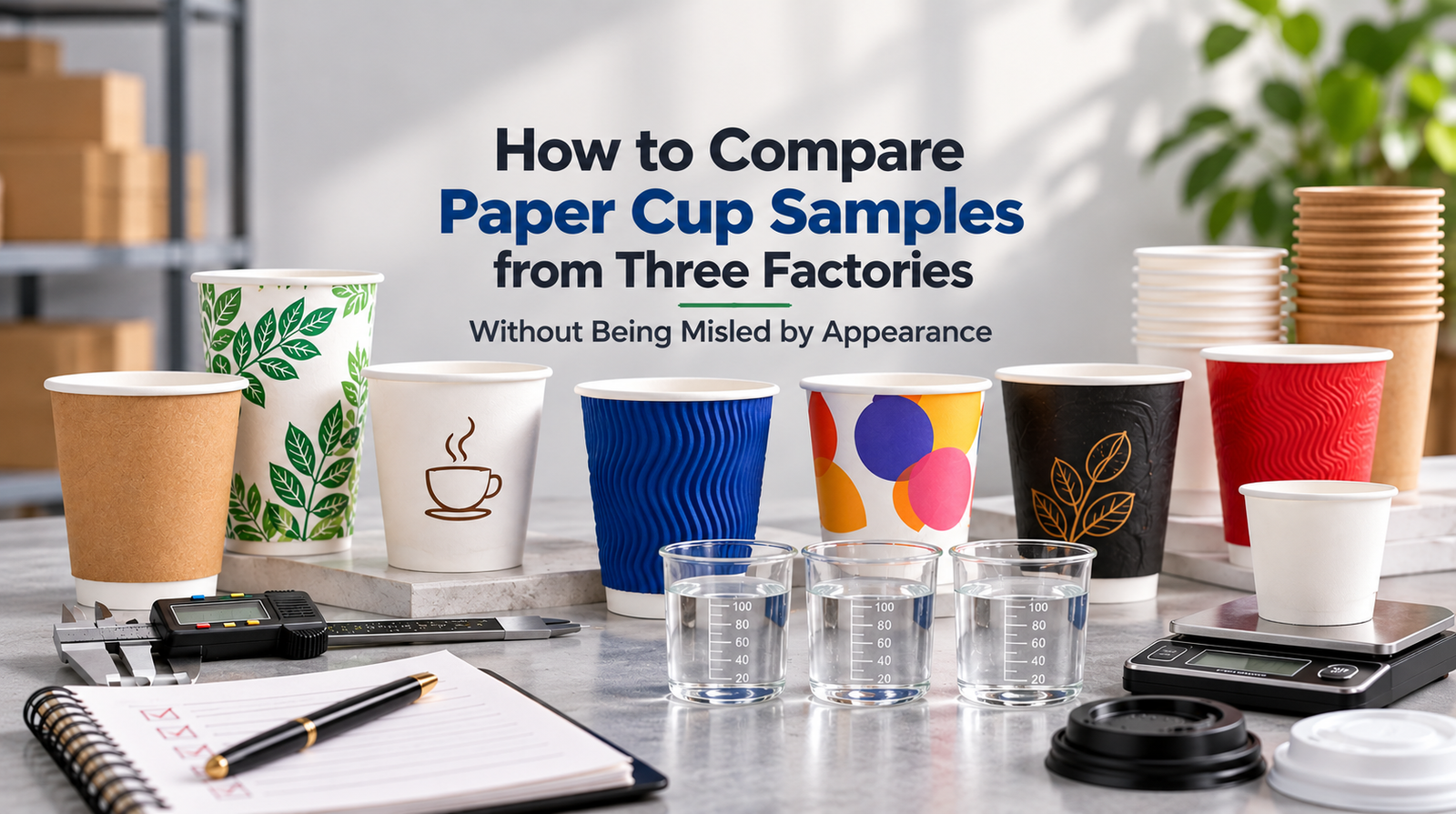
The gap usually isn’t margin. It’s usually a hidden difference in board weight, coating type, or carton packing density. Two suppliers can both tell you “same GSM” and still hand you two different boards.
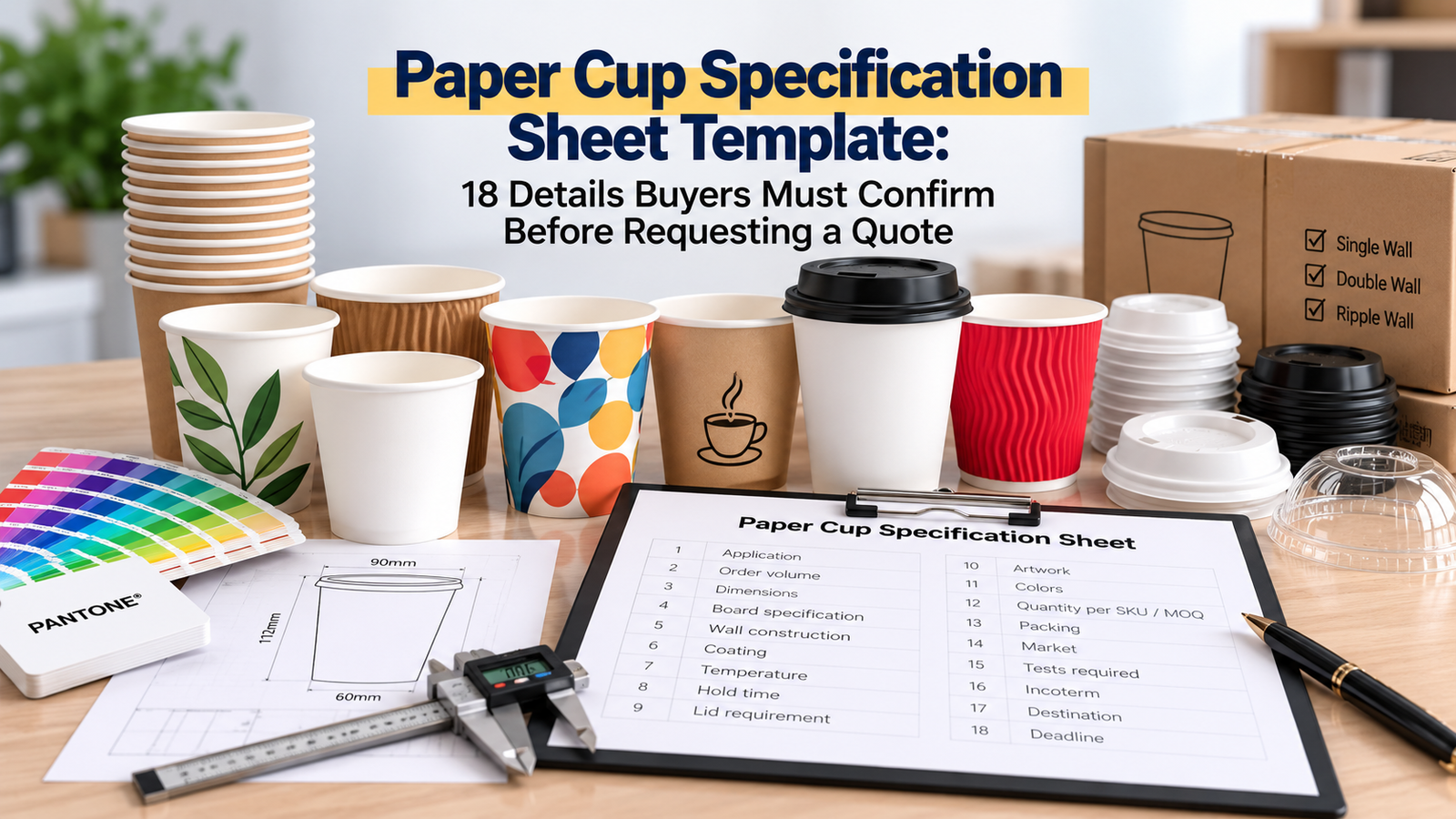
If you compare price alone, you’re comparing incomplete information. You need to see what’s inside each number first. XINNENG’s own quoting guidance makes the same point directly. “12 oz” only states capacity. You have to align on GSM, coating, dimensions, and packing method before you can compare two quotes on equal terms.
Definitions: the four numbers that build your price
Board GSM.
Grams per square meter, the standard measure of paperboard weight. A heavier GSM board usually costs you more per cup, but GSM alone doesn’t tell you everything. Published industry guidance is direct here: two boards at the same GSM can differ in thickness, stiffness, and coating. Don’t treat a matching GSM number as proof of a matching product.
Coating weight.
How much barrier coating, PE, PLA, or water-based, gets applied to your board. Coating type and weight affect your cup’s heat resistance, leak resistance, and printability. Each of those adds or removes cost from your quote. A vague label like “food grade” tells you nothing about actual coating weight. XINNENG’s own marketing describes its board as food-grade, high-gloss, high-hardness white cardboard with soy or corn-based ink. That description alone doesn’t give you a GSM or coating-weight figure either. Ask for the actual numbers before you compare it against another supplier’s spec.
Printing method.
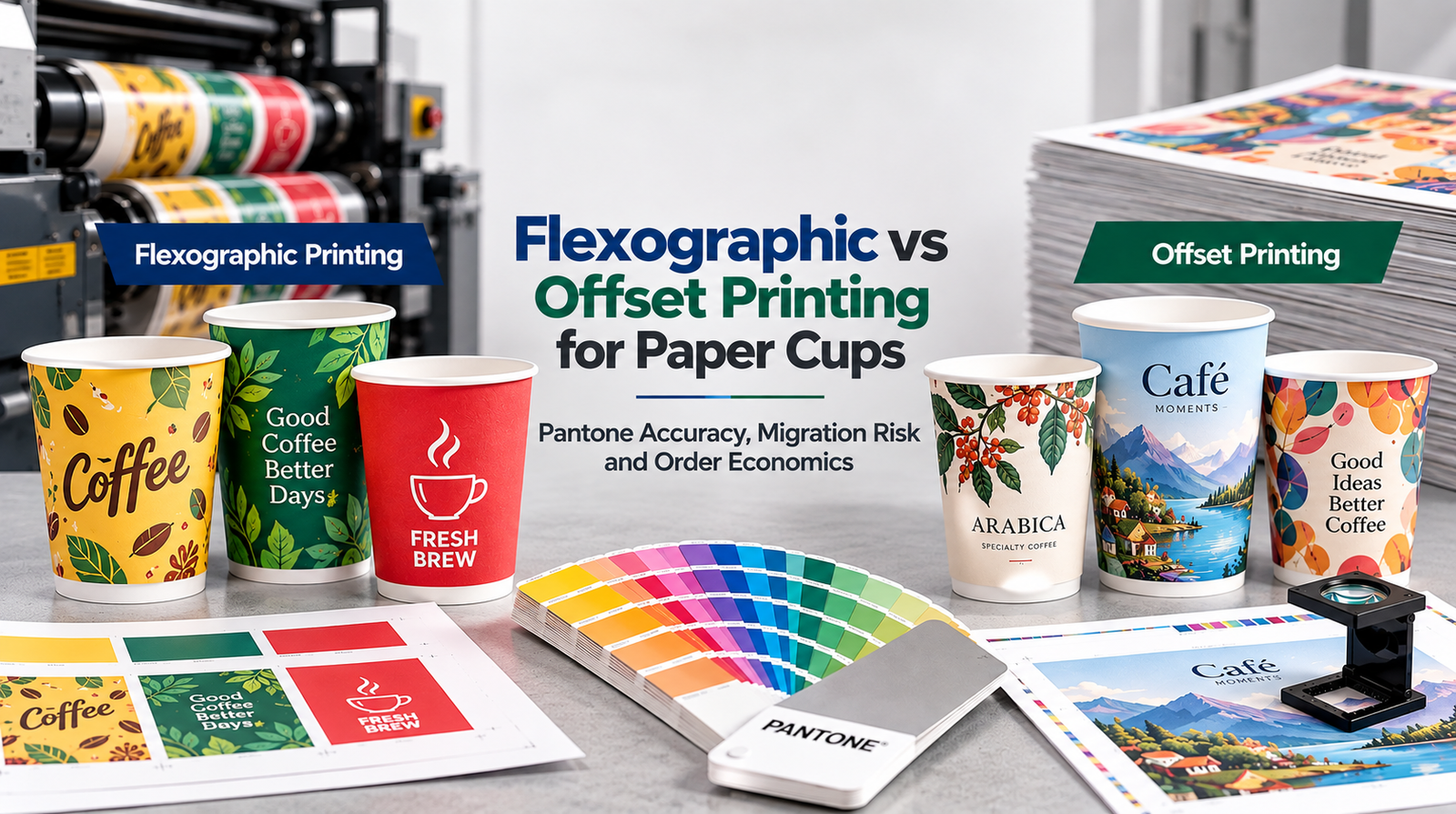
Flexographic and offset are the two common choices for your artwork. Each has a different cost curve. The better choice for you depends on your order volume, not print quality alone.
Carton packing density.
How many cups fit into each shipping carton. A cup that packs less efficiently costs you more per unit in freight. That’s true even when the cup itself is priced the same as a competitor’s.
GSM alone does not define board performance. Two cups sold at the same grammage can behave differently on your forming line once caliper and stiffness enter the picture.

How a factory actually builds your quote
A factory doesn’t quote your cup as one line item. It builds the number from separate inputs, and each one moves independently of the others.
Board GSM is the most visible input on your quote. Published procurement guidance warns against treating it as the whole story, though. Grammage measures mass per area, tested under ISO 536, but it doesn’t show thickness or stiffness. Two boards can hit an identical GSM and still cost differently once you factor in caliper and stiffness.
Caliper is measured under ISO 534, and bending stiffness under TAPPI T 489. Ask your supplier for both values, not just the GSM number, if board performance matters to your application. Two boards priced the same at the same GSM can still behave differently on your forming line.
Coating comes next, and it carries its own cost logic. Published guidance recommends you specify coating type, coated side, coating weight, and your required heat-seal performance. Don’t accept a generic “PE coated” or “food grade” label without those specifics attached.
Water absorption under sustained contact is measurable too, using the TAPPI T 441 Cobb test. A supplier who can share that data is giving you something a vague label never will. Ask for it directly if your beverage sits in the cup for a long hold time.
Printing method changes your cost curve depending on your order size. Offset printing generally carries lower setup costs, which suits your smaller runs well. Its per-unit cost climbs faster at high volume, though, so that advantage doesn’t hold forever.
Flexographic printing usually costs more to set up, since plates take more work to produce. It becomes more cost-effective as your run size grows, though, since that setup cost spreads across more units. The reasoning behind this is simple. Setup, color matching, plate making, scheduling, and labor are fixed costs. They don’t shrink with your order size, so a smaller run spreads those same costs across fewer cups. If you’re ordering a small trial batch, offset often wins on total cost. If you’re ordering at real production volume, flexo often wins instead.
MOQ thresholds shape this decision too. XINNENG’s own quoting policy starts most standard flexo or offset orders around 10,000 pieces. Digital printing is available below that, at a different cost structure, for smaller trial runs. Confirm which printing method your target quantity actually qualifies for before you compare two suppliers’ numbers.
Carton packing density is the cost driver you’re most likely to check last, and that’s a mistake. Published logistics guidance on paper cup shipping notes that even a small gain in packing efficiency compounds across shipments. A cup that nests less efficiently adds a real per-unit freight cost. That cost never shows up on your factory-gate price at all.
What a realistic price comparison looks like
Scope note: this table reflects general industry cost logic drawn from published procurement and manufacturing guidance, not a confirmed price list from any single factory. Your actual quote depends on your specific cup size, spec, and order volume. Ask XINNENG for a line-item quote broken out by these four drivers. That lets you compare it against another supplier’s quote on equal terms.
| Cost driver | What changes the price | What to ask your supplier |
|---|---|---|
| Board GSM | Heavier board costs more per cup, but GSM alone doesn’t confirm performance | Actual caliper and stiffness values, not just GSM |
| Coating weight | Barrier type and thickness affect heat resistance, leak resistance, and cost | Coating type, coated side, and coating weight, not a generic “food grade” label |
| Printing method | Offset suits smaller runs, flexo suits high volume, MOQ shifts the crossover | Your expected order size against your printing quote and MOQ |
| Carton density | Fewer cups per carton raises your landed cost per unit | Cups per carton and carton dimensions, not just the unit price |
A real example shows how much carton density actually varies. XINNENG’s own published carton table lists its 3 oz cup at 5,000 or 10,000 pieces per carton. Its 22 oz cup packs at roughly 1,650. That’s close to a six-fold spread in units per carton across sizes from one factory. Generic industry references often cite a narrower band, roughly 500 to 2,000 cups per carton, for common commercial sizes. The gap between that range and XINNENG’s small-cup figure is exactly why you confirm the real number for your own SKU, rather than trust either range alone.
A 12 oz cup and a 32 oz cup from the same product line can carry sharply different cups-per-carton counts. That’s exactly why you should compare freight cost per unit, not just per carton, for your landed price.
What each type of buyer should do
If two quotes for the “same” cup look far apart, ask both suppliers for your board GSM, caliper, coating type, and cups-per-carton, side by side. The gap usually lives in one of those four fields, not in margin.
If you’re ordering a small trial batch, ask about offset or digital printing first, since your quantity may fall under the standard flexo or offset MOQ anyway. Confirm the crossover point where flexo becomes cheaper for your specific order size.
If you’re placing a high-volume repeat order, ask your supplier to model flexographic printing cost against your actual annual volume. That plate cost amortizes across a much larger run than a trial order ever would.
If you’re trying to combine multiple product lines into one order, ask whether same-size designs can run together to help you clear a supplier’s MOQ. XINNENG’s own guidance flags a real limit here. Each design, size, and color combination can still count as its own SKU. Confirm the actual savings before you assume combining designs cuts your cost in half.
If your landed cost feels high despite a competitive factory-gate price, check your cups-per-carton figure before blaming freight rates. A less efficient carton spec can quietly erase savings you thought you locked in on the unit price.
If a supplier quotes “food grade” coating without specifics, ask for the actual coating type, coated side, and weight. That gap in a quote often signals a gap in documentation you’ll need later, not just a pricing shortcut.
Compare cups per carton and landed cost per unit, not factory-gate price alone. A carton spec that looks “close enough” can quietly double your freight share on the same unit price.
Where this guidance doesn’t generalize
The cost logic here reflects general, published procurement and manufacturing guidance, alongside real published figures for the specific product line noted above. It isn’t a confirmed price list from any single factory. Actual pricing depends on your cup size and target market’s compliance requirements. It also depends on current raw material costs and your supplier’s own cost structure.
The cups-per-carton figures cited above, both the generic industry range and the manufacturer-specific table cited earlier, are reference points, not a guarantee for your exact SKU. MOQ thresholds and sample costs can also shift with current policy. Ask for a real, itemized quote before treating any figure in this article as your expected price.
FAQ
Why do two suppliers quote different prices for the same GSM board?
GSM alone doesn’t fully define a board. Two boards at the same weight can differ in caliper, stiffness, and coating. Each of those differences affects your price and your cup’s performance.
Is flexo or offset printing cheaper for my order?
It depends on your volume. Offset usually wins for your smaller runs, thanks to lower setup cost. Flexo usually wins at higher volume, since its higher setup cost spreads across more units. Your quantity also needs to clear your supplier’s MOQ for either method.
Does a heavier board always mean a better cup?
Not necessarily. Heavier GSM raises your material cost. Your cup’s real performance depends more on caliper, stiffness, and coating than on weight alone.
How much does carton packing density actually affect my total cost?
More than most buyers expect. A less efficient carton spec raises your per-unit freight cost across every shipment, and the spread between cup sizes can be several times over. That happens even when your factory-gate unit price stays the same.
What should I ask for if a quote just says “food grade coating”?
Ask for the coating type, which side is coated, the coating weight, and any barrier or heat-seal data your supplier can share. A vague label leaves you unable to compare that quote against anyone else’s.
How much should I expect to pay for a sample before committing to a full order?
Costs vary by supplier and sample type. Published XINNENG pricing guidance puts a standard mock-up at roughly ¥100 per time and an on-press sample at roughly ¥500. Confirm current pricing directly for your order, since policy can change.
Get a line-item quote for your exact spec
Send XINNENG your cup size, target board GSM, coating requirement, printing preference and expected order volume, and ask for a quote broken down by the main cost drivers: board, coating, printing and packing. A line-item quote lets you compare against any other supplier on equal terms, and shows you exactly where your budget is going.