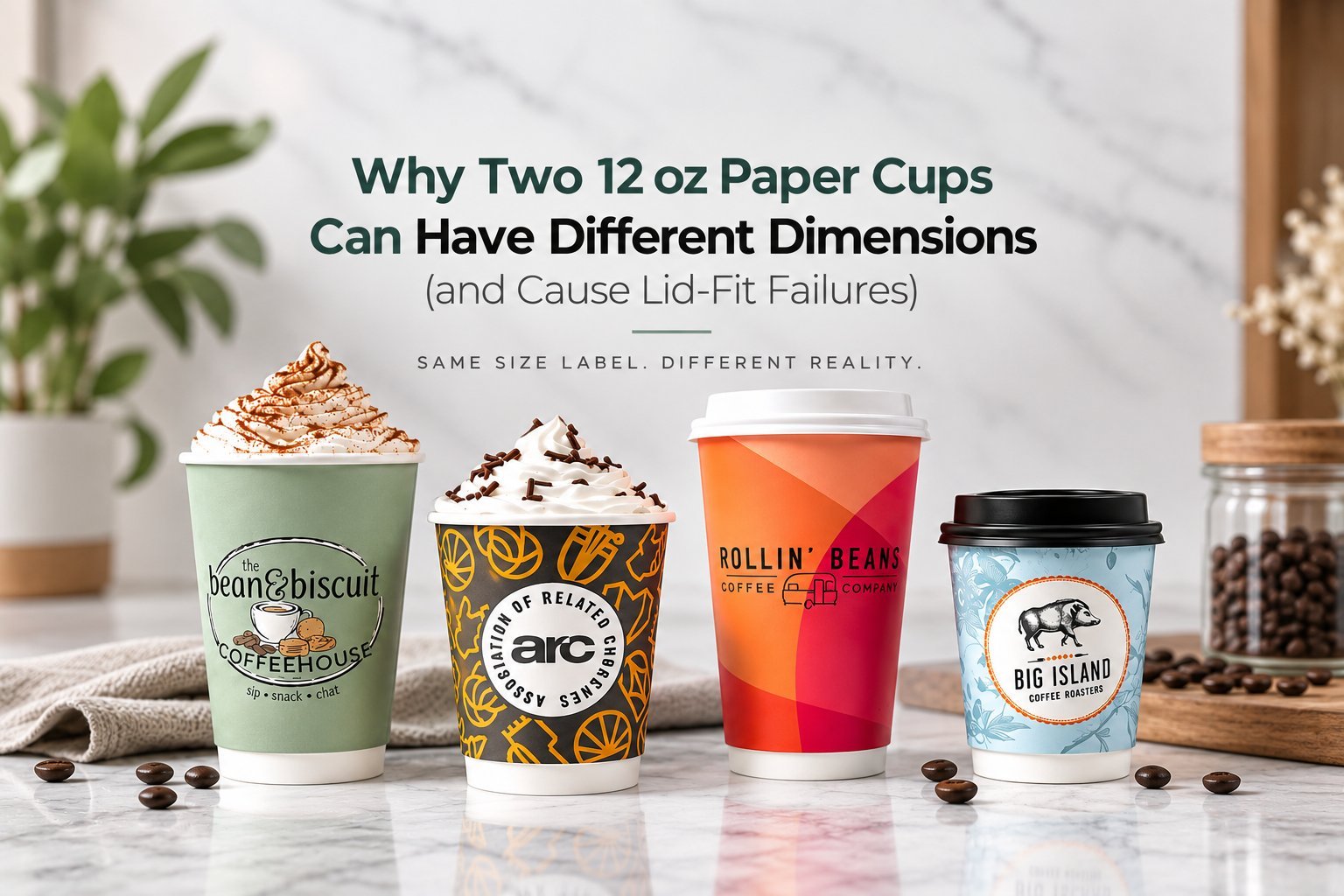
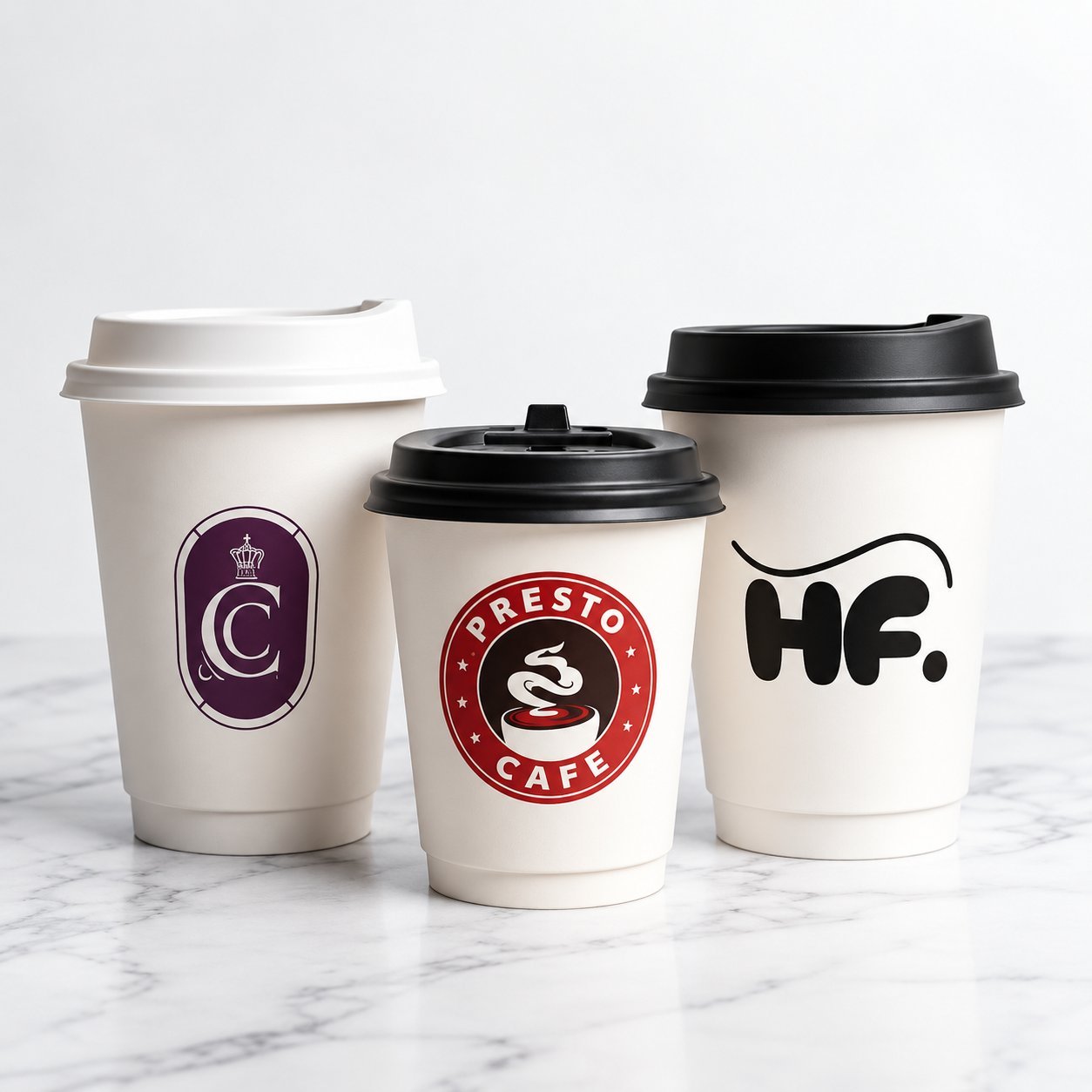
Two 12 oz paper cups can measure completely differently. One brand’s cup might have an 89mm rim. Another might measure 90mm, and XINNENG’s own 12 oz mold measures closer to 80mm at the top. That gap causes real paper cup lid-fit failures at the counter. The ounce label never tells you the rim diameter. You have to measure the actual rim before you commit to a lid pairing.
The problem you’re actually solving
You order a new batch of 12 oz cups. Your existing lids stop fitting. Nobody changed the lid. Nobody told you the cup changed either.
This happens because "12 oz" isn’t a dimensional standard. It’s a volume label. Two factories can hit that volume with different rim diameters. They can also use different wall angles and different heights. You end up comparing labels, not the part that actually matters.
Paper cup lid fit depends on rim diameter, not on the ounce label. It has nothing to do with the number printed on the cup. If you pair cups and lids from different production runs, you’re accepting real risk. That risk shows up as leaks, pop-off lids, and frustrated staff.
The cost of this mistake isn’t just a bad customer moment. You lose time chasing a complaint that looks like a lid defect. It’s actually a rim mismatch. You lose product to spills in transit. Approve a new cup SKU without checking rim diameter, and you can end up holding lid stock that no longer matches anything you sell.
None of this makes you a materials engineer. It just means asking one specific question every time you change a cup or a lid. Stop treating the ounce label as if it answers that question for you.

Definitions: what actually determines lid fit
Rim diameter.
The measurement across the rolled edge of the cup, sometimes listed on a factory spec sheet as the top opening diameter. You take it with calipers, not with a size chart. This is the number you actually need. Ask your supplier for it directly instead of assuming it from the label.
Nominal size.
The marketed volume of the cup, like "12 oz." Nominal size tells you almost nothing about rim diameter. Compare two 12 oz cups from different suppliers, and expect the rim measurements to differ.
Rim curl.
How the top edge of the cup rolls over during forming. Curl shape and tightness vary by machine setting, board stiffness, and coating type. Switch cup suppliers, and you’re also switching curl profile, even if nobody mentions it.
Forming tolerance.
The acceptable range of variation a factory allows during production. Every factory has one, including whichever factory makes your cups. A tighter tolerance gives you more consistent cups. A looser tolerance means more variance batch to batch.
Lid compatibility zone.
The narrow diameter range where a specific lid design actually seats on your cup. Published buyer guidance draws a hard line here. Treat 89mm and 90mm lids as different specifications, not close-enough substitutes.
How rim diameter actually varies between cups
Published buyer guidance lists seven common commercial rim diameters, and your own cups likely fall into one of them. Roughly 62mm covers small 2 to 4 oz cups. 80mm covers 6 to 8 oz cups, and 83mm covers 8 to 10 oz cups. Both 89mm and 90mm show up in the 10 to 20 oz range you probably order most. 98mm covers 16 to 24 oz cups, and 104mm covers larger 24 to 32 oz cold cups.
Notice that two different diameters, 89mm and 90mm, both serve the size range you’re most likely buying in. That’s exactly the trap. Your cup and your lid can both be correctly made. They can both fall in the right general size class. They still might not fit each other.
A real example makes this concrete. XINNENG’s own current spec sheet lists its 12 oz cup at roughly 80mm across the top opening, alongside 53mm at the base and 112mm in height. That sits a full class below the 89mm to 90mm range generic industry guidance associates with 10 to 20 oz cups. XINNENG’s documentation notes these figures as reference measurements, confirmed against the physical sample before an order ships, which is exactly the discipline this article recommends. One real 12 oz cup and one generic industry reference point already disagree by close to a centimeter, and you haven’t even compared two separate suppliers yet.
This isn’t a defect you can complain your way out of. It’s a design choice each factory makes on its own. Nothing forces two factories making a 12 oz cup to agree on a rim diameter. You can’t assume compatibility just because two SKUs share a size label.
Manufacturing tolerance adds a second layer of variance, and most buyers never see this part until it costs them. A peer-reviewed study published in the journal BioResources looked at how paperboard properties affect cup forming. The study found that a material’s coefficient of friction drives most dimensional defects during forming, a variable you’ll rarely see on any spec sheet.
That mattered more than compression strength on its own. Higher-friction materials showed more variation in side seam width once machine settings changed. Rim roll height itself shifted by roughly 0 to 4 percent depending on the material, even under the same machine setting, and your supplier’s material choice affects your rim the same way.
Two cartons of what should be identical cups can carry small rim differences. That happens even from the same factory, if the paperboard batch changes. A lid that fit your last order perfectly can feel loose or tight on this month’s stock, with nothing else changed on purpose.
Heat adds a third variable. Published guidance on lid fit and material choice notes something specific here. A cup that feels solid and well-formed at room temperature can shift its rim profile once you fill it hot. That shift can be enough to unseat a lid that fit fine on an empty, cool sample. If your product ships hot, a cool empty test won’t tell you what your customer actually experiences.
It helps to picture the forming process behind your own cups. A cup starts as a flat, pre-printed blank. A forming machine wraps that blank around a mandrel and seals the side seam. It attaches and seals the base, then rolls the top edge over a curling die to shape the rim.
Every step leaves a small mark on the finished rim diameter: mandrel size, seam overlap, curling pressure. You’re not dealing with one variable in your own supply chain. You’re dealing with a chain of them, and each factory’s own tooling becomes that factory’s rim diameter, independent of what anyone else decided. That’s also why, as XINNENG’s own product guidance puts it, asking a factory which mold sizes it already runs is worth doing before requesting a custom rim. A cup built on an existing mold usually costs less and ships faster than one built around a brand-new tool.
What the published data shows about rim size and fit risk
Scope note: this table reflects published industry reference ranges for common commercial rim sizes, not a confirmed specification for every factory. That real 12 oz measurement, cited above, shows how far an actual cup can sit from these general classes. Always confirm the exact rim measurement for the SKU you’re ordering, whichever supplier you use.
| Approximate rim diameter | Typical cup size range | Fit risk if mismatched |
|---|---|---|
| 62mm | 2-4 oz | Low, small lids rarely get cross-paired |
| 80mm | 6-8 oz | Moderate, close to the 83mm class |
| 83mm | 8-10 oz | Moderate, close to the 80mm class |
| 89mm | 10-20 oz | High, easily confused with 90mm |
| 90mm | 10-20 oz | High, easily confused with 89mm |
| 98mm | 16-24 oz | Moderate |
| 104mm | 24-32 oz | Low, distinct from smaller classes |
Use this table to start a conversation with your supplier, not to replace one. If your cup falls in the 10 to 20 oz range, treat rim diameter as the single most important number on your spec sheet. That’s exactly where 89mm and 90mm sit side by side and get confused most often.
What you should actually do about it
If you’re ordering a new lid for an existing cup, don’t trust the ounce label on either part. Ask your supplier for the exact rim diameter in millimeters. Match the lid to that number, not to the size printed on the box.
If you’re switching cup suppliers but keeping your current lid, treat the new cup as untested until you measure it yourself. A supplier change is one of the most common ways this problem shows up, since the new factory has no reason to match the old one’s rim diameter. XINNENG’s own sourcing guidance makes a related point: cups and lids don’t have to come from a single factory, but any new pairing should be tested together, not assumed compatible, before you commit to a production run.
If you’re troubleshooting a complaint about lids popping off, measure several cups from the current carton first. Pull samples from the top, middle, and bottom of the stack. A batch-level material change can shift the rim just enough to cause the problem.
If your product is served hot, test your cup and lid pairing filled and at your actual serving temperature. Heat-related rim shift is a documented failure mode. A cool, empty test sample won’t catch it.
If you’re launching a new custom-printed cup, build the rim measurement check into your approval process from the start. A printed proof tells you nothing about rim diameter. Approving artwork isn’t the same as approving fit.
If you manage multiple cup sizes on one menu, keep a written record of the confirmed rim diameter for each SKU. Don’t rely on the ounce size alone. That record protects you the next time anyone considers a change.
Where this guidance doesn’t generalize
The rim diameter ranges above are general industry reference points, useful for planning your own comparison, not a guarantee for any specific cup or supplier. A factory can legitimately choose a rim diameter outside these typical bands and still produce a correctly made cup.
Manufacturing tolerance also varies by factory, by paperboard batch, and by how tightly the forming line runs. Even two cups from the same supplier aren’t automatically identical. Those real spec figures cited earlier are treated the same way in this article: reference numbers, not a substitute for measuring your actual production sample. If lid fit matters to your business, measure your actual cup and lid together, whichever supplier you use.
FAQ
Why did my lid stop fitting when nothing in my order changed?
Your paperboard batch or your supplier’s forming settings likely shifted slightly. Published research shows rim dimensions can vary by a few percent under normal production, with no change to your order at all.
Is 89mm close enough to 90mm to use interchangeably?
No, and you shouldn’t treat them that way. Published guidance treats these as separate specifications. That one millimeter is a documented source of leaks and pop-off lids on exactly the sizes most buyers order.
How many cups should I measure before trusting a fit?
More than one, and definitely more than the single sample your supplier hand-picks for you. Pull samples from different points in the stack, since forming variance can differ across a single run.
Does a heavier board fix lid-fit problems?
Not by itself, so don’t reach for that first. Your rim fit depends more on friction properties, forming consistency, and rim curl than on board weight alone.
Can I mix a cup from one supplier with a lid from another?
You can, but treat it as unverified until you measure both rims. The same logic applies here: buying both from one source isn’t mandatory, but test the pairing together before you order in bulk.
Does asking for a factory’s existing mold size save you money?
Often, yes. Building a new mold around a custom rim target costs more and takes longer than choosing a size a factory already produces. Ask XINNENG which mold sizes are already running before you request a custom one.
What should I send my supplier when I request a matching lid?
Send your current cup, or the exact rim diameter in millimeters if you already have it. A vague request like "a lid for a 12 oz cup" gives your supplier nothing to match against.
Get the right cup & lid fit before you order
Send XINNENG your current cup or lid and your target rim diameter in millimeters, then ask for samples of the cup and lid together before you commit to a production run. Matching a rim you can measure is faster than approving each part separately, and an existing mold size usually costs less than a custom one.