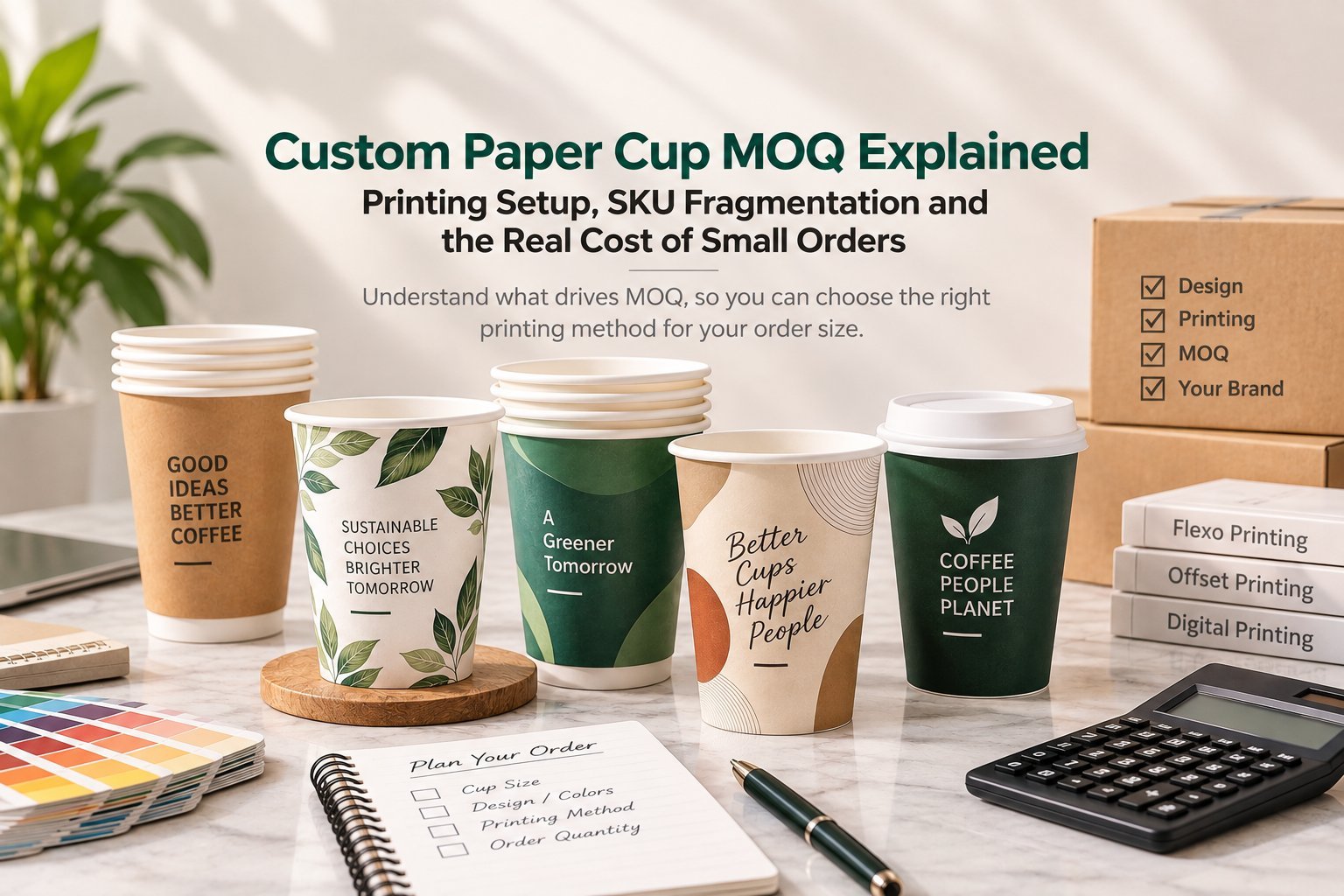
Your paper cup MOQ isn’t about raw material. It’s about setup cost. A printing plate or cylinder costs the same whether you order 5,000 cups or 500,000. Suppliers spread that fixed cost across your order, so a small order means a high setup cost per cup. That’s the real reason MOQs exist, and why they vary so much between suppliers and printing methods.
Why your MOQ feels arbitrary
You ask two suppliers for a quote. One sets a 500-unit minimum. Another won’t touch your order below 20,000 units. Neither number is random, but neither one gets explained to you clearly either.
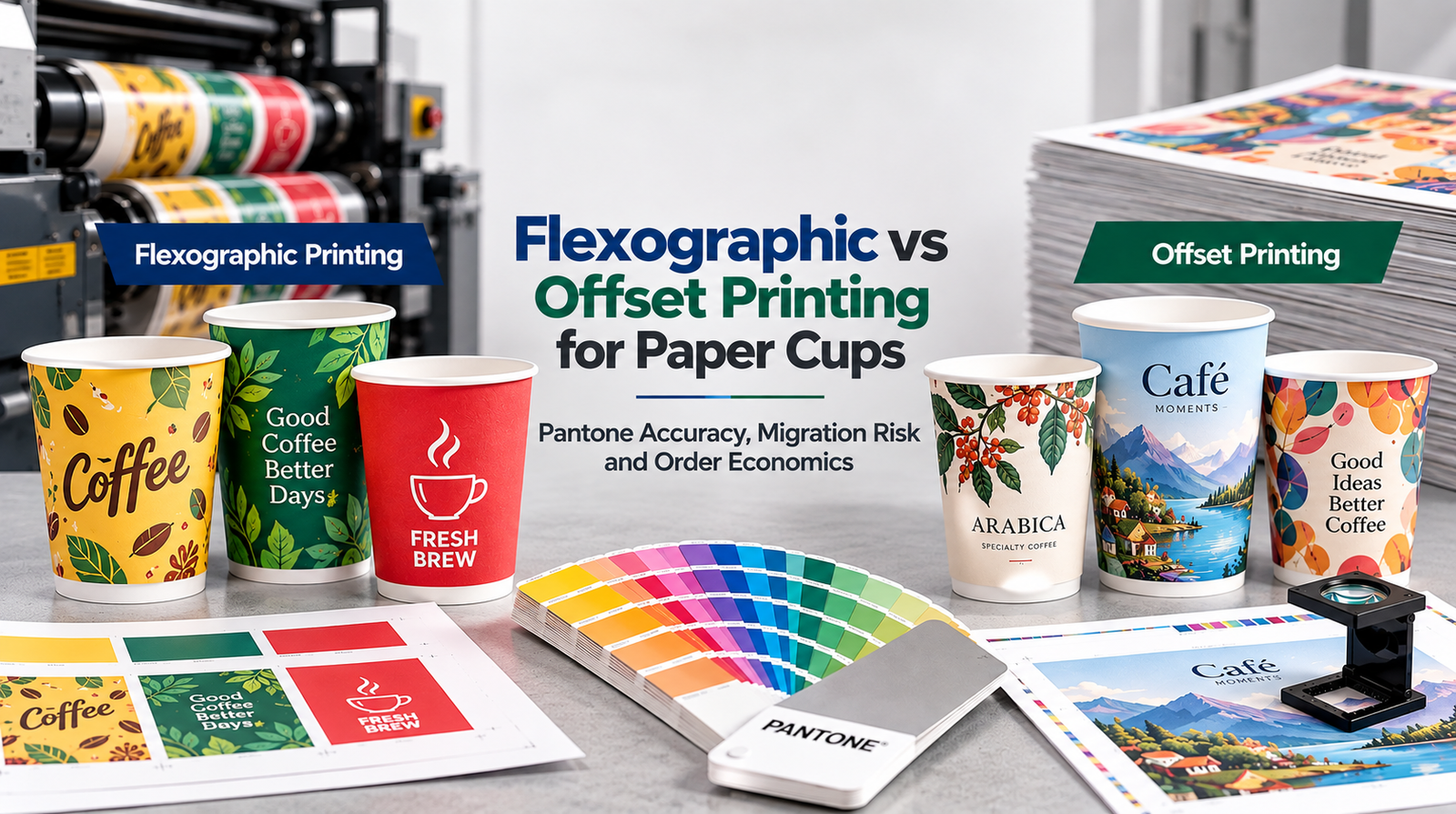
The difference usually comes down to printing method your supplier runs, not supplier generosity. A factory running flexographic printing has real plate costs to recover. A factory offering digital printing has none, so it can accept a much smaller order from you. XINNENG’s own MOQ policy puts a real number on this pattern. Standard flexo or offset orders typically start around 10,000 pieces, with digital printing available below that threshold.
Your “SKU” also matters more than you might expect. Each size counts as a separate production run, with its own setup cost. Each new design or color count adds another cost layer on top of that. Two cup sizes with the same artwork still means two separate MOQs, not one combined order.
This surprises a lot of first-time buyers. You assume your total order volume, across every size and design, is what a supplier weighs against their minimum. In practice, most suppliers weigh each SKU on its own. Your 30,000-cup order split across three sizes can still trigger three separate 10,000-unit minimums. It won’t clear one comfortable 30,000-unit threshold instead.
What’s actually behind that number
Printing setup is the fixed cost of preparing a press to run your design. For flexographic printing, that means producing a plate for every single color. Published industry figures put flexo plate cost at roughly $200 to $500 per color. Offset printing needs plates too, priced somewhere around $150 to $400 per plate. Its strength is photo-quality detail, not long-run efficiency. XINNENG’s own file guidance matters here too. Supply vector AI, PDF, or EPS artwork with colors specified in CMYK or Pantone. A low-resolution image can slow your proofing before your MOQ even enters the conversation.
Digital printing skips plates entirely. Setup cost drops to effectively zero, which is exactly why digital suppliers can quote MOQs as low as 500 to 5,000 cups. You trade that low minimum for a higher cost per cup once your volume climbs. Digital never gets the benefit of spreading a fixed plate cost across a huge run.
Specialty processes reset this math again. Metallic gold or silver printing, for example, usually runs as its own special process with a different cost structure. XINNENG’s own guidance flags that this can carry a different MOQ than a standard color run. If your design calls for metallic ink, confirm the MOQ for that specific process before assuming your standard-color quote still applies.
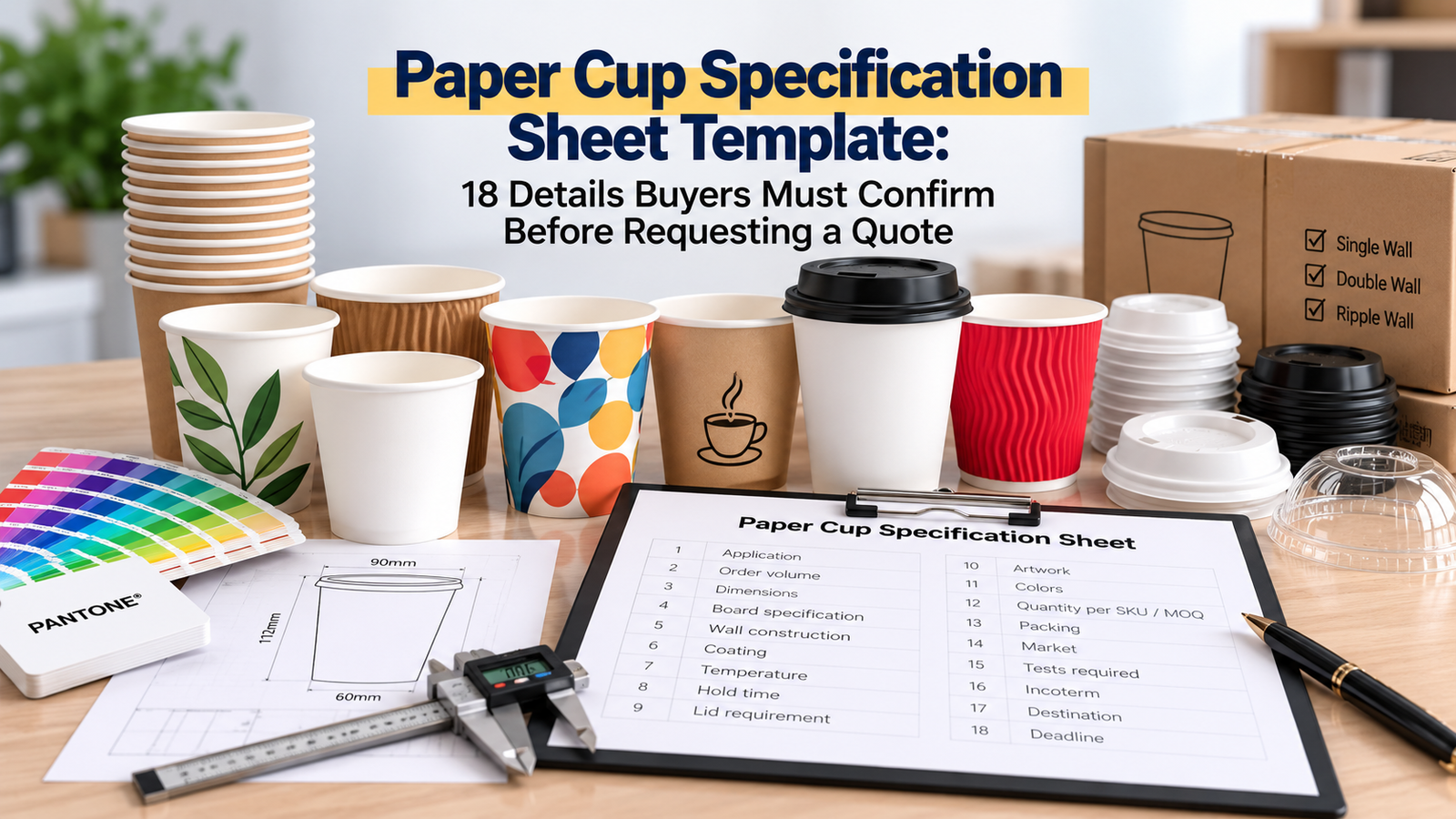
SKU fragmentation describes what happens when you split one order across multiple sizes, designs, or color counts. Each split resets the setup-cost math from scratch. Published supplier guidance is blunt about this: your MOQ typically applies per size and per design, not to your total order. XINNENG’s own quoting rule works the same way. Same-size designs can sometimes run together in one production run. But each design, size, and color combination still counts as its own SKU. Picture an order of three cup sizes in two color designs each. By that counting rule, you’re looking at six separate SKUs. That’s not one combined order sized at six times your per-SKU volume, even when every design shares the same base artwork file.
Color count adds its own layer on flexo runs specifically. Every additional color needs its own plate and its own print station. Published guidance notes that dropping a five-color design to three colors is often invisible to your customers. It’s still meaningfully cheaper per cup, since you’re removing two full plate costs from your setup.
The setup-cost math suppliers don’t explain
Published figures for an 8 oz cup with a two-color design show how sharply printing method changes your per-unit cost at different volumes.
These figures come from one published industry cost breakdown, not a confirmed price list from any single factory. Exact numbers shift with cup size, ink coverage, and your specific supplier’s equipment. XINNENG’s own baseline MOQ of roughly 10,000 pieces sits inside the offset band of this table. That’s a useful anchor point, even though it isn’t a confirmed price. Treat the pattern, not the exact figures, as the takeaway: digital wins at low volume, flexo wins at high volume, and offset sits in between.
| Order volume | Flexo cost/cup | Offset cost/cup | Digital cost/cup |
|---|---|---|---|
| 500 | Not viable | Not viable | ~$0.025 |
| 5,000 | Not viable | ~$0.015 | ~$0.012 |
| 50,000 | ~$0.006 | ~$0.008 | ~$0.020 |
| 500,000 | ~$0.003 | ~$0.006 | Not viable |
Notice where the lines cross. Digital costs less per cup than flexo at 5,000 units, but costs far more at 50,000. That crossover point is exactly why your MOQ should match your printing method to your actual order size, not the other way around.
Matching order size to printing method
If your order sits near a crossover point, ask your supplier to quote both methods side by side. A few thousand units either way can flip which method actually saves you money.
This matters most if your business is growing. A method that made sense for your first 5,000-unit trial order might already be the wrong choice by your third reorder. Revisit this comparison whenever your typical order size shifts meaningfully, not just once at your first purchase.
| Your order size | Method that usually fits | Why |
|---|---|---|
| Under 5,000 cups | Digital | No plate cost, so low volume doesn’t get penalized |
| 5,000 to 10,000 cups | Digital or offset | Near most standard MOQ thresholds, worth quoting both |
| 10,000 to 50,000 cups | Offset | Moderate setup cost, good detail, reasonable per-unit price |
| 50,000+ cups | Flexo | Plate cost amortizes fully, lowest cost per cup at scale |
| Multiple sizes, frequent redesigns, or metallic ink | Digital, or confirm a separate quote | Variable data avoids repeat setup cost, and specialty processes carry their own MOQ regardless of volume |
Before you assume “small order means overpriced”
A high per-unit price on a small order usually reflects real setup cost, not a markup aimed at you specifically. Suppliers vary widely in what MOQ they’ll accept. A digital-first shop might take 500 units, while a flexo-focused factory wants 50,000 or more. Shop your order size against the right kind of supplier, rather than assuming one number applies everywhere.
The cost figures in this article come from published industry sources, not a confirmed rate card from any single factory. They’ll shift with your cup size, color count, ink coverage, and whether your design needs a specialty process like metallic printing. Ask for your own quote at your actual order size before treating any number here as your expected price.
FAQ
Why does my MOQ apply per cup size, not my whole order?
Because each size in your order triggers its own setup cost. Published supplier guidance confirms this is standard, not a one-off policy from a difficult factory.
Can I get a lower MOQ by simplifying my design?
Often yes, especially on flexo runs. Dropping colors removes plate costs directly, and published guidance notes a simpler design is frequently invisible to your customer anyway.
Is digital printing always cheaper for small orders?
Usually, but not universally. Digital wins clearly under about 5,000 units. Above that, offset or flexo typically overtakes it on cost per cup, so check your specific volume against the crossover point.
Why did one supplier quote me 500 units and another 20,000?
They likely run different printing methods for your job. A digital-first supplier has no plate cost to recover, while a flexo-focused factory needs volume to justify its setup investment. XINNENG’s own standard threshold sits around 10,000 pieces for flexo or offset, for comparison.
Does ordering more of one size ever reduce my MOQ on a different size?
No, and this catches many buyers off guard. Each size and design combination resets its own setup cost in your order, sometimes counted as its own SKU even when it shares artwork with another size. A larger order on one SKU doesn’t offset the minimum on another.
Does metallic or gold and silver printing change my MOQ?
Often, yes. Specialty processes like metallic ink typically run under a different cost structure than standard colors, and that can carry its own MOQ. Confirm the minimum for that specific process before assuming your standard quote applies.
Should I combine a small trial order with my next reorder to hit a better price?
Only if your supplier treats them as one production run. Ask directly whether combining orders actually pools your setup cost. Some suppliers will let you do this, and others treat each purchase order as a separate run regardless of timing.
Get your MOQ broken down by cost driver
Send XINNENG your target order size, number of cup sizes, color count and any metallic or specialty finish requirements. Ask which printing method actually fits your volume against XINNENG’s own roughly 10,000-piece standard threshold, and which part of your order — printing method, color count, specialty process, or SKU count — is actually driving your minimum.