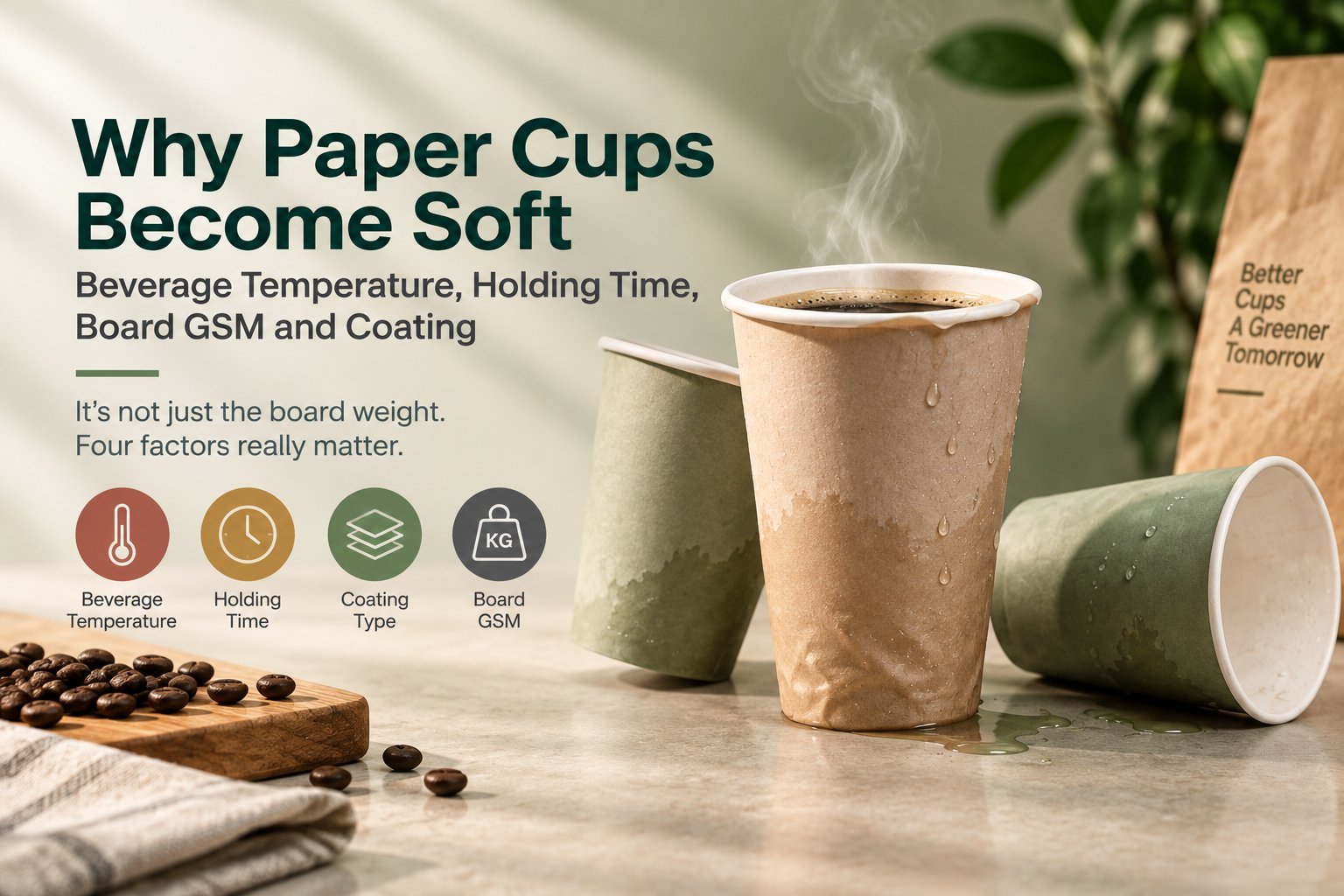
A paper cup goes soft when heat and moisture reach the raw fiber underneath your coating. That happens through pinholes, worn seals, or a coating that softens at your serving temperature, not because your board is too light. Four factors combine to cause it: fill temperature, holding time, coating type, and coating continuity. Board GSM matters far less than most buyers assume.
The complaint that isn’t really about board weight
A customer reports a cup that felt fine at pickup and mushy by the time they finished their drink. You check your spec sheet. Your GSM looks correct. You’re not sure what actually went wrong.
Most buyers reach for board weight first, since it’s the easiest number to check. Published manufacturing guidance says this instinct usually points you the wrong way. GSM alone misleads you here, and the real cause almost always sits somewhere else in your cup’s construction.
Softening is a barrier failure, not a paper-weight failure. Once you understand what’s actually breaking down, you can ask XINNENG or any supplier the right question instead of just requesting a heavier board.
XINNENG’s own guidance to buyers lays out nearly the same four-factor picture for you. Heat and moisture enter the paper fibers, and coating, bottom seal, paper structure, drink temperature, and dwell time all play a role, not just GSM. That’s a real supplier independently confirming this article’s own framework, not a competing theory.
Four things that actually cause your cup to go soft
Fill temperature and coating type
Your coating has a heat limit, and crossing it is one of the most direct causes of softening. Published data puts PLA coating’s softening point at roughly 55 to 60°C. Some sources note deformation starting as low as 50°C, well below your typical coffee or tea serving temperature.
PE coating performs across ordinary hot beverage conditions, with no comparable published failure point. That’s why you’ll still see it on most hot cups, despite its recyclability tradeoffs. Water-based coatings suit your standard café hot-beverage service too, though published sources give it less margin than PE at the high end.
If you’re serving drinks above roughly 60°C and a supplier proposes a PLA-coated cup, that’s a mismatch worth questioning directly. Ask XINNENG which coating matches your actual serving temperature range before you commit to a spec.
Holding time and moisture migration
Heat alone doesn’t fully explain softening. Time matters just as much, since moisture needs time to migrate through your coating and reach the fiber underneath. Published testing methodology profiles continuous exposure at 90 to 95°C. That combination of heat and duration reveals failures a quick fill-and-check misses.
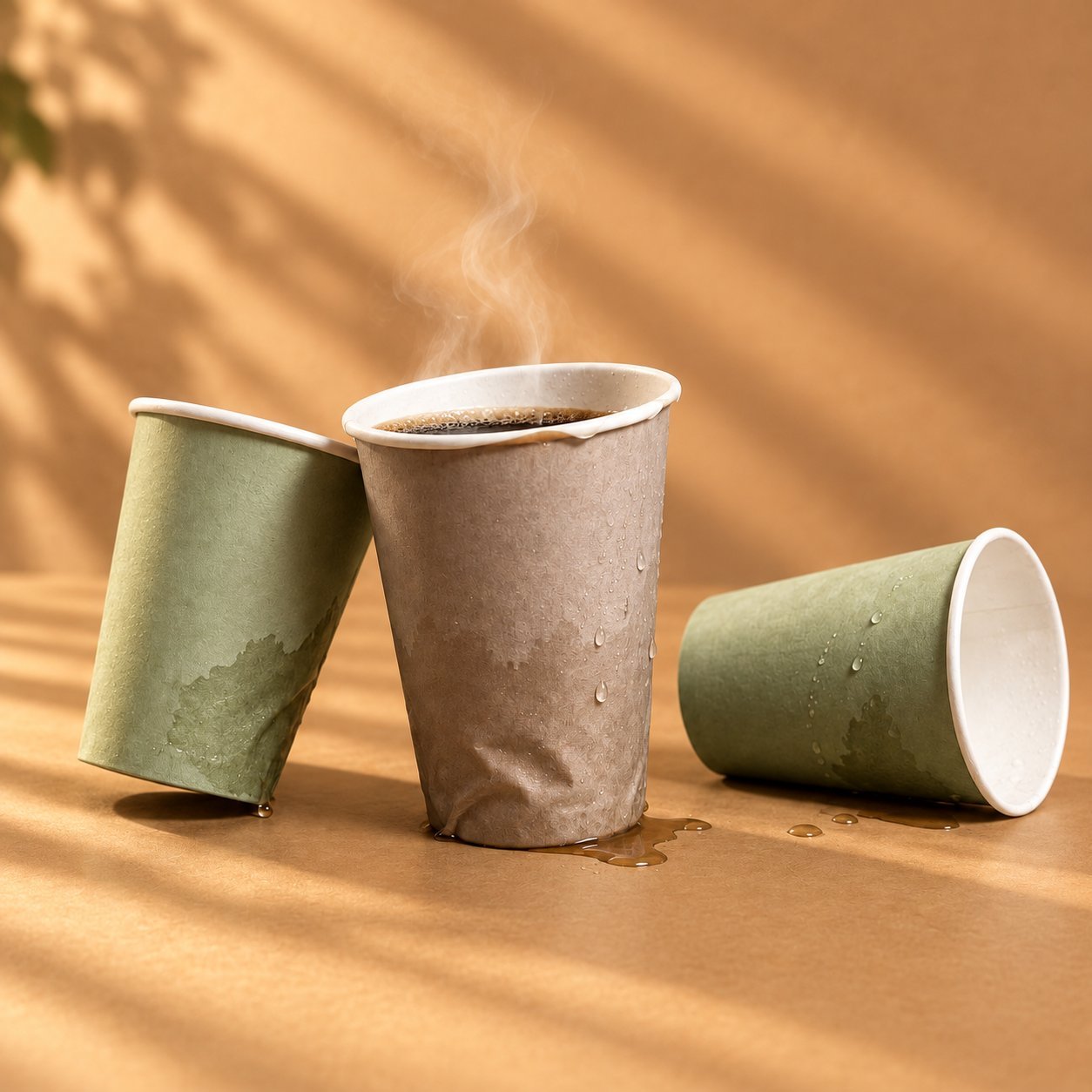
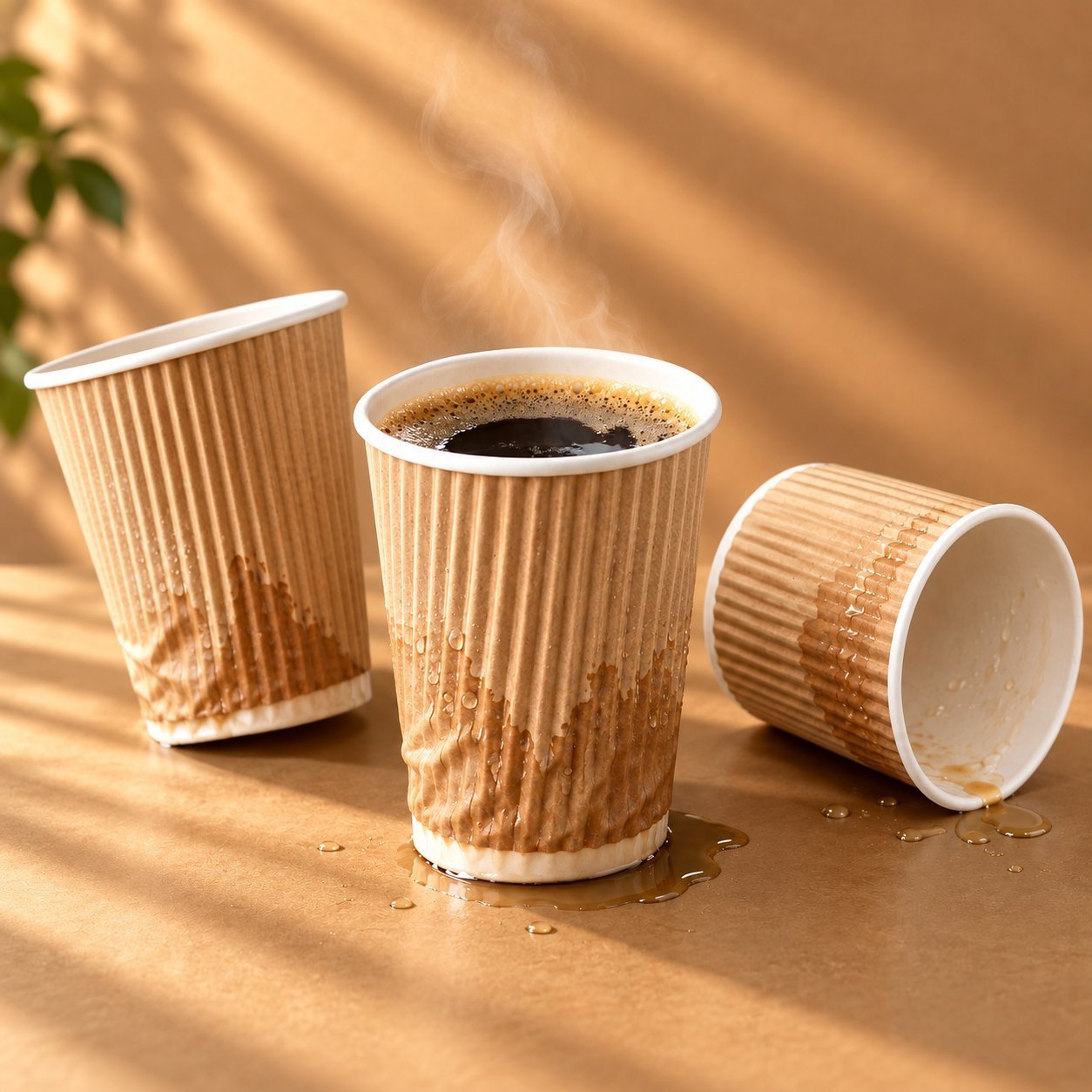
Base seal softening and micro-seepage rank among the most common real-world failure modes reported to suppliers. This shows up especially often after a switch to lower-cost materials. This failure often doesn’t show up in your first few minutes. It shows up after your customer has been holding the cup for a while, which is exactly when they notice it most.
If your drinks typically sit in a customer’s hand for an extended period, tell your supplier that explicitly. A cup rated fine for a quick counter transaction isn’t automatically rated fine for a 45-minute commute.
Coating continuity, not just coating thickness
A barrier coating works by sealing the microscopic pores in your paperboard. Published materials science describes cellulose fibers as naturally water-absorbing. Once a coating gap exposes them, capillary action draws liquid straight in.
The critical requirement isn’t thickness. It’s continuity. A thin, fully continuous coating outperforms a thick one riddled with pinholes. Even a microscopic gap gives moisture a path to your fiber. Common failure points documented in published guidance include incomplete coating activation at your side seam, worn forming tooling. Reduced coating weight that leaves gaps in the barrier is another.
Ask your supplier how they verify coating continuity on your actual production run, not just on a sample batch. That verification step is where a real quality process shows up.
Cold drinks aren’t automatically immune
You might assume softening is only a hot-drink problem, but that’s not quite right. XINNENG’s own guidance draws a direct line for you on cold cups too. Double-side coating resists softening on a cold-drink cup, while single-side coating still goes soft. If your cold-cup order runs single-side coating to save cost, confirm that tradeoff first. Check it against your condensation and ice exposure, not just your fill temperature.
Board GSM and caliper, the factor buyers overweight
Heavier board can help your cup in some comparisons, but published guidance is direct that it’s just one factor among several. Caliper, stiffness, and coating fit matter more. So do cup structure, rim formation, base construction, and production consistency, all ahead of raw GSM alone.
Water absorptiveness itself is measurable, using the TAPPI T 441 Cobb test. That figure tells you more about your actual moisture resistance than a GSM number does. Ask XINNENG for that data if softening resistance matters for your specific application.
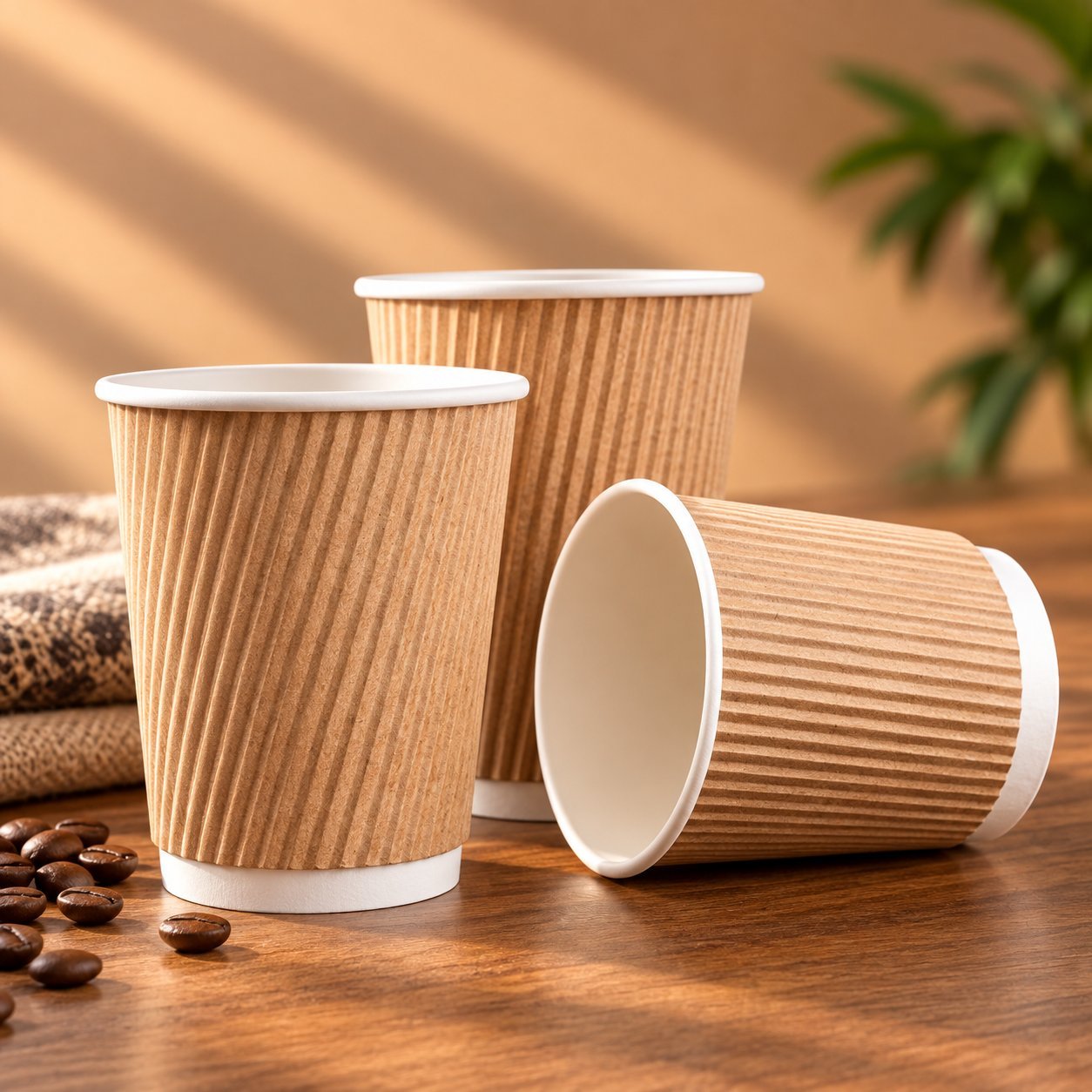
XINNENG’s own guidance backs up the same priority order. Stiffness, coating, forming, and bottom seal all factor into your actual result, alongside your specific usage scenario. A thicker board costs you more, too, so match thickness to your purpose rather than defaulting to heavier by habit.
Myth vs. mechanism: what buyers get wrong about softening
| Common belief | What’s actually happening |
|---|---|
| A heavier board automatically prevents softening. | GSM alone misleads you. Caliper, stiffness, and coating fit matter more than raw weight, and a heavier board with a compromised coating can still soften. |
| If it doesn’t leak in the first few minutes, it’s fine for a long hold. | Softening is a slower failure than an obvious leak. Base seal micro-seepage commonly shows up well after your first few minutes, not immediately at fill. |
| Every plastic-coated cup performs the same in your hot service. | Coating type sets a real heat ceiling. PLA softens around 55 to 60°C, while PE and water-based coatings hold up across typical hot beverage temperatures with more margin. |
| A thicker coating always protects better than a thinner one. | Continuity beats thickness. A thin, pinhole-free coating outperforms a thick one with gaps, since moisture only needs one weak point to reach your fiber. |
| Switching to a cheaper material won’t change how your cup performs. | Published buyer reports link base seal softening directly to material substitutions. Your cup can look identical and still behave differently once the material underneath changes, even with your beverage temperature and hold time unchanged. |
Where this guidance doesn’t generalize
Softening behavior depends on your specific coating formulation, your forming line’s consistency, and your actual serving conditions, not a single universal threshold. The temperature figures here come from published industry and materials sources, not a confirmed XINNENG specification.
Your real beverage, your real hold time, and your real customer behavior all vary from any published test condition. Confirm actual performance with a sample run at your own serving temperature and hold time before committing to a full production order.
FAQ
Does a higher GSM board always resist softening better?
Not reliably. Published guidance treats GSM as one factor among several. Caliper, coating fit, and production consistency all play a larger role in your actual result.
What temperature should make me question a PLA-coated cup for my order?
Anywhere above roughly 55 to 60°C. That’s where published sources report PLA beginning to soften, and your standard hot coffee or tea service typically exceeds it.
Why does my cup feel fine at pickup but soft by the time my customer finishes it?
Softening is a time-dependent failure. Moisture needs time to migrate through any coating gap. Your cup can hold up fine for the first few minutes and still soften well before your customer’s last sip.
Is a thicker coating always the safer choice for my order?
Not by itself. Continuity matters more than thickness, so ask your supplier how they verify a continuous, pinhole-free barrier rather than assuming thickness alone solves it.
Can I test for softening risk before committing to a full order?
Yes. Request a sample run tested at your actual serving temperature and expected hold time, not just a quick room-temperature check.
Does switching suppliers or materials always cause a softening issue?
Not always. Published buyer reports do flag material substitutions as a common trigger, though. Confirm any material change against your original spec before you approve it.
Can a cold-drink cup go soft too, or is this only a hot-drink issue?
It can. XINNENG’s own guidance notes that single-side coating still softens on a cold cup, while double-side coating resists it. Confirm which one you’re actually ordering before you assume cold drinks are automatically safe.
Get Your Cup Matched to Your Actual Serving Conditions
Tell XINNENG your typical beverage temperature and how long your cup usually stays in a customer’s hand. Ask which coating type and board combination actually fits those conditions, rather than defaulting to a heavier board alone.