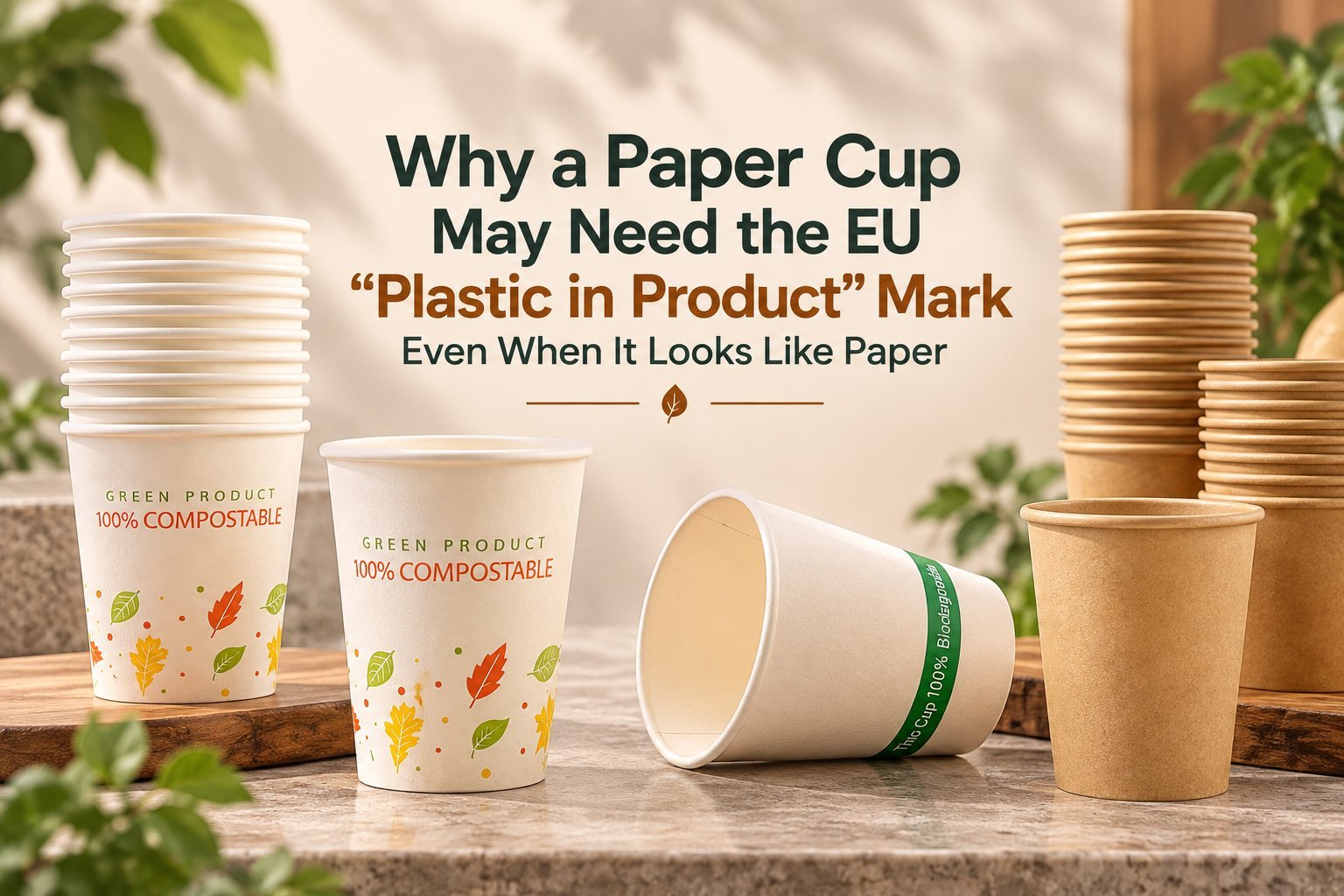
You need this marking when your cup has any plastic coating or lining, even a thin one for leak protection. The EU treats a plastic-lined paper cup as a composite product. It calls that product “partly plastic” and requires a specific pictogram and text on its external surface. This article walks through which cups the rule applies to, what the marking looks like, and how to plan it into your artwork so the print run ships compliant.
You’re sourcing a “paper” cup for the EU market. It looks like paper. It feels like paper. Then your compliance team tells you it still needs a plastic marking on the side.
The problem you’re actually solving
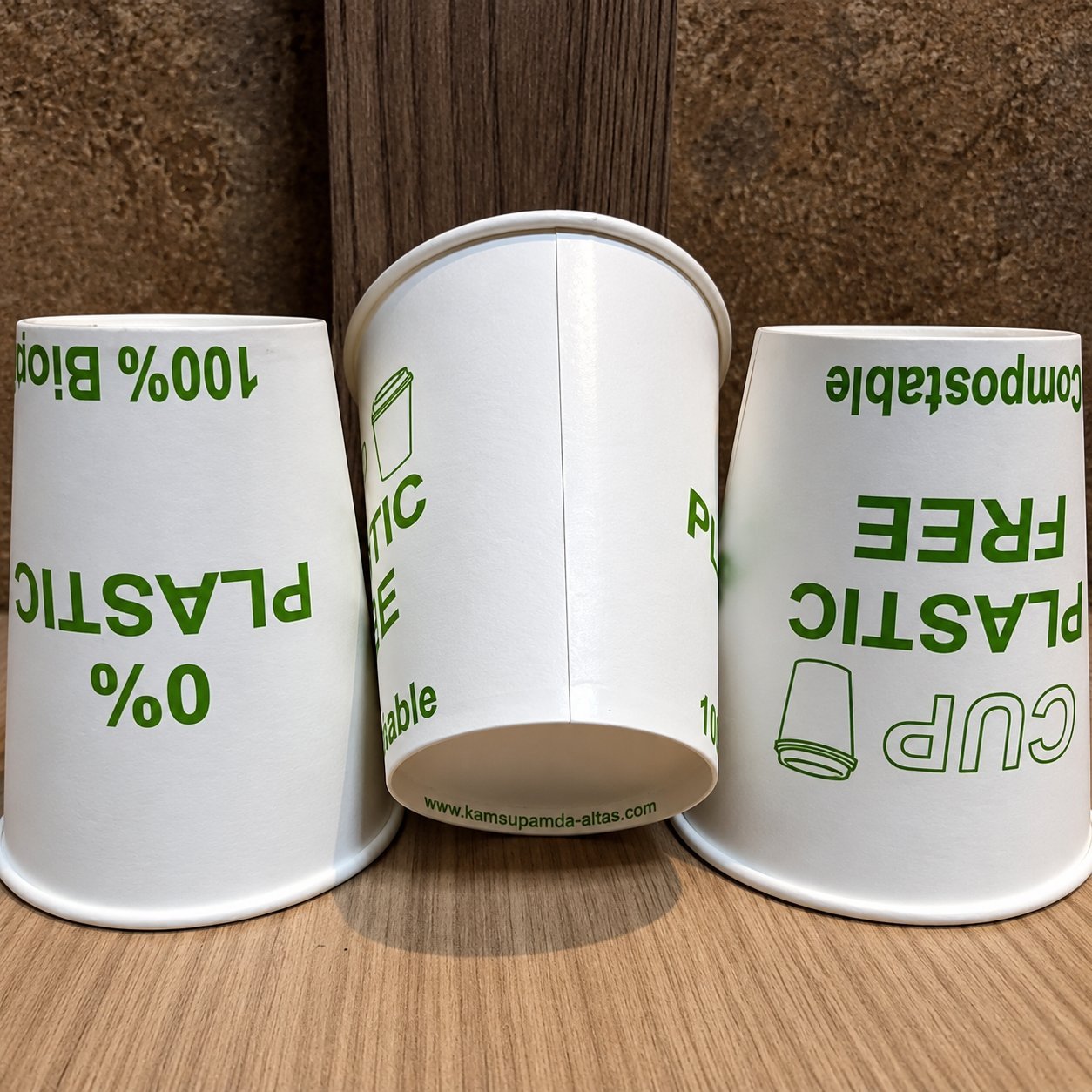
This confuses most buyers the first time they hear it. You’re judging the cup by its visible material, not its full composition. A cup with an internal PE or PLA coating isn’t a paper product under EU rules — it’s a composite product, and the marking applies.
Get your artwork wrong here, and you don’t just get a cosmetic problem. Missing or incorrect marking on a beverage cup shipped into the EU can trigger a market-compliance failure. It’s not a customer complaint you can refund. It’s a market-access issue. We see the same confusion on both custom and stock print runs, which is why the requirements below matter before you approve artwork, not after.
Definitions: what actually triggers this rule
Legal basis. You’ll find the marking obligation in Directive (EU) 2019/904, the Single-Use Plastics Directive. Commission Implementing Regulation (EU) 2020/2151 sets the exact marking specifications. The European Commission publishes the official pictogram and required wording in every official EU language on its marking specifications page.
Composite product. The European Commission’s own guidance (2021/C 216/01, published 7 June 2021) addresses this directly. It states that when a plastic coating or lining goes onto a paper or board base, the resulting product is a composite product partly made of plastic. That status — not the look of the cup — is what brings it into the marking rule.
Partly plastic vs. wholly plastic. The regulation splits marking text into two versions. You use “PLASTIC IN PRODUCT” for a cup made partly from plastic, like your typical PE- or PLA-lined paper cup. You use “MADE OF PLASTIC” only for a cup made entirely of plastic. Most paper-cup SKUs that buyers ask about fall into the first category.
Scope confirmation for beverage cups specifically. The Commission’s guidance doesn’t stop at a general definition. It lists worked examples by product type. Table 4-8 of that guidance explicitly lists beverage cups and containers as falling within the marking scope when they meet the composite-product definition. That’s the part of the rule most relevant to your EU-bound orders.
| Cup type | Required marking text | Why |
|---|---|---|
| PE- or PLA-lined paper cup | PLASTIC IN PRODUCT | Composite product: paper base + plastic lining |
| Cup made entirely of plastic | MADE OF PLASTIC | Single-material product, not composite |
| Compostable PLA-lined cup | PLASTIC IN PRODUCT | Compostability does not remove plastic status |
| Fully unlined, uncoated paper cup | (none required) | No plastic component = outside the marking scope |
| Bio-based or novel lining | Confirm with destination state | National transposition may differ from EU baseline |
![A shelf of white paper cups printed with 'GREEN PRODUCT 100% COMPOSTABLE' and a leaf-graphic band, with one cup also carrying a small 'This cup is made from pla[stic] not oil' label — an example of a partly-plastic compostable cup whose composite-product status still triggers the EU marking under the Commission's plastic definition.](https://xinnengpack.com/wp-content/uploads/2026/09/clipboard-2026-09-24T10-56-05-279Z-c42179a2.jpg)
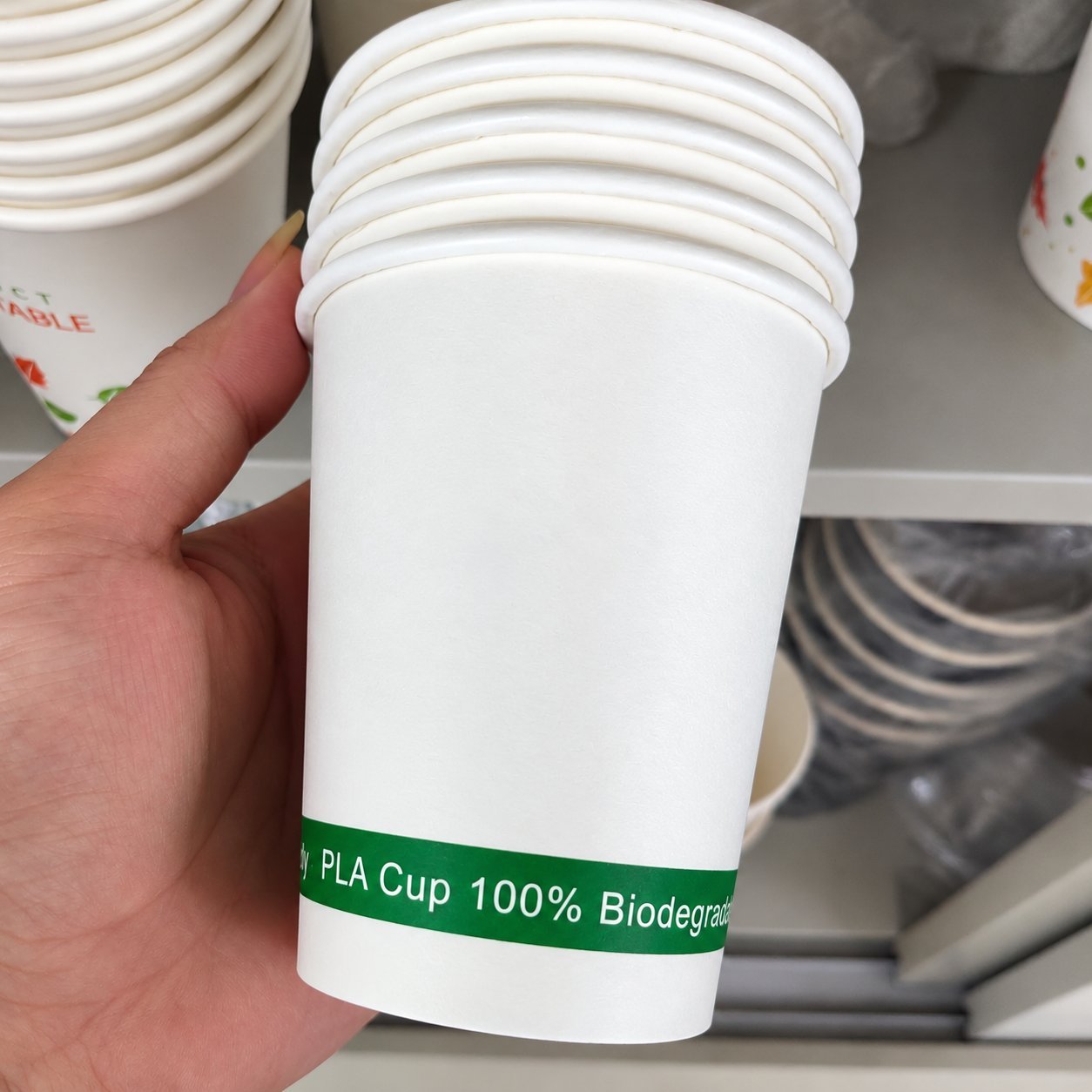
The classification looks at composition, not how the cup markets itself. A cup printed with “100% COMPOSTABLE” graphics can still be a partly-plastic composite product if the lining itself is a plastic. That distinction matters more than any marketing claim printed on the cup wall.
How the marking itself is specified
You don’t get to interpret the pictogram design. The implementing regulation fixes it. Use the table below as your pre-flight check before approving any EU-bound print run. Each row comes from the regulation or the Commission’s official marking page — confirm the exact text against the current source before quoting it on customer-facing documents.
| Requirement | Specification |
|---|---|
| Pictogram | Two equal-sized red and blue boxes side by side, with a black rectangular box beneath containing the marking text |
| Box ratio | 1:2 (height to length) |
| Marking text | "PLASTIC IN PRODUCT" for cups partly made of plastic; "MADE OF PLASTIC" for cups wholly made of plastic |
| Minimum size, cups under 500ml | 1.4cm × 2.8cm |
| Minimum size, cups 500ml or more | 1.6cm × 3.2cm |
| Placement | Horizontal, on the external cup surface, away from the rim (to avoid mouth contact); may rotate 90° if space is limited; never on the base |
| Application date | The regulation has applied since 3 July 2021 |
| Source | Commission Implementing Regulation (EU) 2020/2151 and the European Commission’s official marking specifications page. |
How this plays out in your artwork workflow
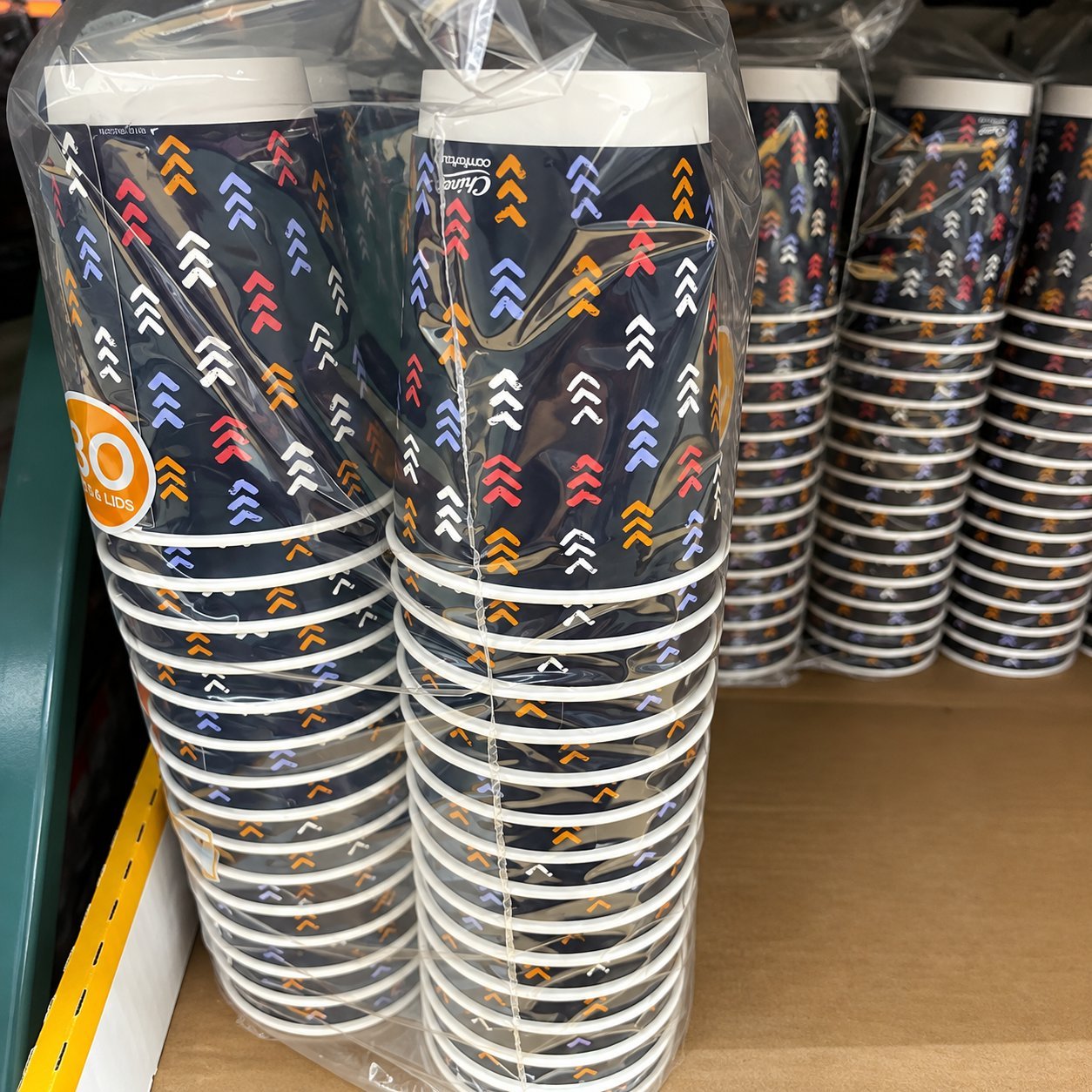
Marking placement competes with your brand artwork for the same physical space on your cup. You need to plan it in, not bolt it on at the last step. Most production issues come from artwork that filled the rim-adjacent zone first, leaving no compliant place to put the marking without redoing the print plate.
Rim-adjacent zones are already off-limits for the marking under the regulation. In practice, that’s also where a lot of brand artwork wants to sit. Confirm your cup’s target market and container size before artwork is locked, so the marking zone and your branding are designed around each other instead of fighting for the same wraparound space. Our quality-control process checks marking placement before plate release for EU-bound orders.
Language matters too. The Commission publishes the marking pictogram and required wording in every official EU language. Your correct language variant depends on the destination market you’re shipping into, not the language printed elsewhere on your artwork. Don’t reuse an English-only print plate for a French, German, or Italian destination without confirming the local language variant is on the cup.
Print position tolerance matters here too, not just for brand consistency but for marking compliance itself. A marking that drifts outside its required size or placement zone during production is a defect, even if the design itself was correct on the print file. Add a marking-zone check to your pre-press QC for any EU-bound run.
Where this guidance doesn’t generalize
This article explains the general EU-level rule and its official source documents. It isn’t legal advice. It doesn’t replace a review by qualified compliance counsel for your specific market and product. Treat the figures, sizes, and dates here as your starting point for that review, not as your final answer.
National transposition of the Single-Use Plastics Directive isn’t identical across every EU member state. How a given country defines “plastic” in its own implementing law can affect edge cases, particularly around novel bio-based or compostable materials. Verify your destination country’s specific implementing text before assuming the EU-level rule is the only one that applies.
This article also doesn’t cover a separate question: whether your specific market requires additional labeling under national extended producer responsibility schemes. That’s a different obligation from the marking rule above and adds its own requirements. Confirm both against your destination market before you finalize any artwork or print run.
FAQ
Does a fully unlined, uncoated paper cup need this marking?
No. If your cup has no plastic coating, lining, or plastic component at all, it isn’t a composite product under this rule. The marking doesn’t apply. The trigger is the presence of plastic, not the cup’s outward appearance.
Is a compostable plastic lining exempt from this marking requirement?
No, not automatically. The Commission’s guidance treats your coating by its plastic definition, not by its biodegradability or compostability. A compostable plastic lining is still plastic under this rule, unless your national authority confirms otherwise for your specific material.
Can we use a sticker instead of printing the marking directly?
For cups already placed on the market before the regulation’s transition cutoff, you could use a sticker as a transitional measure. For new print runs going forward, confirm with your compliance reviewer whether your market still allows stickers or requires the marking printed directly.
Does the marking replace food-contact or material-safety documentation?
No. This marking addresses single-use plastics labeling specifically. It’s separate from food-contact compliance documentation, which covers a different legal requirement entirely.
Who decides which marking text applies to our cup?
Your cup’s actual construction decides. A cup with any plastic lining or coating takes “PLASTIC IN PRODUCT.” A cup made entirely of plastic takes “MADE OF PLASTIC.” Confirm your cup’s construction with your supplier before you choose.
Before you approve artwork for an EU market
Tell us your destination market and container size before we finalize your print-ready artwork. We’ll confirm the correct marking text, language, size tier and placement zone for your cup. You can browse our current paper cup range while you plan your order, or get in touch through our Kontaktieren Sie uns page to start the conversation.